Inherited property sale proceeds require capital-gains treatment where ownership is supported by evidence, not suspicion or unverified signature doubt...
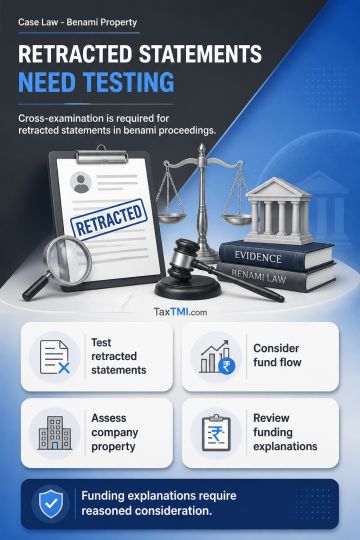
Cross-examination of retracted statements is essential where foundational evidence supports a benami allegation and documented funding explanations re...
Capital-goods exemption covers plant-modernisation accessories, while the import restriction applies only to earlier capital-goods components and spar...
Constitutional judicial review permits challenges to ECIRs and connected money-laundering proceedings where coercive action affects fundamental intere...
Classification of services provided by Grant Thornton, India to develop the "Grant Thornton" brand name and the payment received towards reimbursement of "Brand Development Expenses". It examines whether these services constitute business auxiliary services or intermediary services, and whether they qualify as export of services. The Tribunal held that Grant Thornton, India was not acting as an intermediary but providing services on its own account for promoting the brand in India. The transaction did not fall under the intermediary services rule, and the place of provision was the location of the recipient, Grant Thornton, London, outside India. As payment was received in convertible foreign currency, the conditions for export of services were satisfied. The Tribunal relied on previous decisions clarifying the meaning of intermediary services and the scope of export of services. It concluded that Grant Thornton, India was not an intermediary, and the services provided to Grant Thornton, London constituted export of services, dismissing the appeal against the order dropping the proceedings.
Classification of services provided by Grant Thornton, India to develop the "Grant Thornton" brand name and the payment received towards reimbursement of "Brand Development Expenses". It examines whether these services constitute business auxiliary services or intermediary services, and whether they qualify as export of services. The Tribunal held that Grant Thornton, India was not acting as an intermediary but providing services on its own account for promoting the brand in India. The transaction did not fall under the intermediary services rule, and the place of provision was the location of the recipient, Grant Thornton, London, outside India. As payment was received in convertible foreign currency, the conditions for export of services were satisfied. The Tribunal relied on previous decisions clarifying the meaning of intermediary services and the scope of export of services. It concluded that Grant Thornton, India was not an intermediary, and the services provided to Grant Thornton, London constituted export of services, dismissing the appeal against the order dropping the proceedings.
Note: It is a system-generated summary and is for quick reference only.
 TaxTMI
 of 4786




















 Join Channel


 TaxTMI