Rectification of mistake remains limited to self-evident record errors, preventing merits review through miscellaneous applications and preserving fin...
Tender creditworthiness conditions may extend to de facto Promoter Directors, with post-participation challenges generally barred absent arbitrariness...
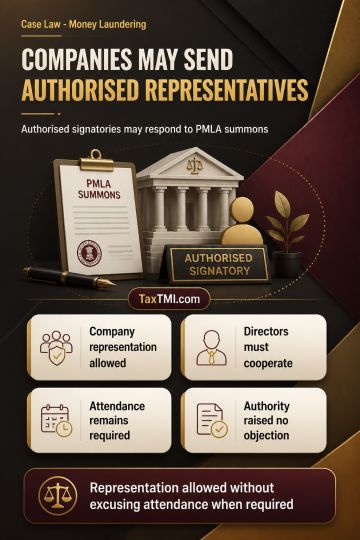
Corporate representation in PMLA summons proceedings permitted through an authorised signatory, subject to directors' continuing cooperation and atten...
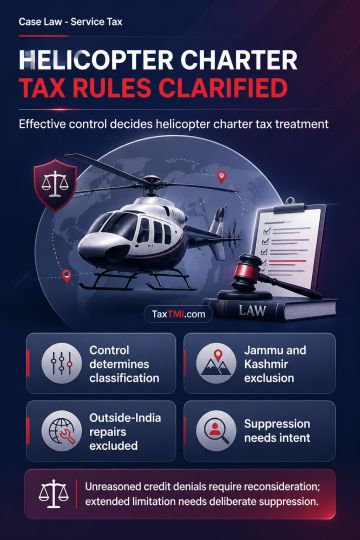
Helicopter charter classification requires effective control analysis, while territorial performance, reasoned credit orders and wilful suppression de...
Page of 4796
Press 'Enter' after typing page number.
781 to 800 of 95918 Results
❮
❯
❯❯
0 / 200
Expand Note
Add to Folder
No Folders have been created
+
Are you sure you want to delete "My most important" ?
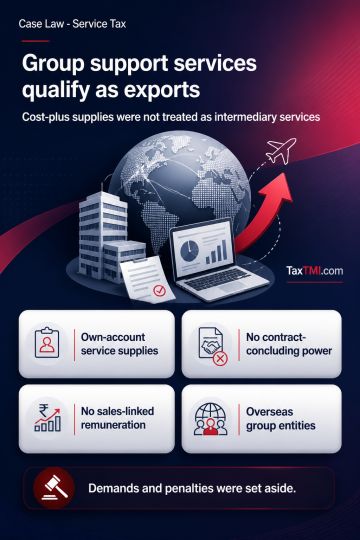
Classification of services provided by Grant Thornton, India to develop the "Grant Thornton" brand name and the payment received towards reimbursement of "Brand Development Expenses". It examines whether these services constitute business auxiliary services or intermediary services, and whether they qualify as export of services. The Tribunal held that Grant Thornton, India was not acting as an intermediary but providing services on its own account for promoting the brand in India. The transaction did not fall under the intermediary services rule, and the place of provision was the location of the recipient, Grant Thornton, London, outside India. As payment was received in convertible foreign currency, the conditions for export of services were satisfied. The Tribunal relied on previous decisions clarifying the meaning of intermediary services and the scope of export of services. It concluded that Grant Thornton, India was not an intermediary, and the services provided to Grant Thornton, London constituted export of services, dismissing the appeal against the order dropping the proceedings.
Classification of services provided by Grant Thornton, India to develop the "Grant Thornton" brand name and the payment received towards reimbursement of "Brand Development Expenses". It examines whether these services constitute business auxiliary services or intermediary services, and whether they qualify as export of services. The Tribunal held that Grant Thornton, India was not acting as an intermediary but providing services on its own account for promoting the brand in India. The transaction did not fall under the intermediary services rule, and the place of provision was the location of the recipient, Grant Thornton, London, outside India. As payment was received in convertible foreign currency, the conditions for export of services were satisfied. The Tribunal relied on previous decisions clarifying the meaning of intermediary services and the scope of export of services. It concluded that Grant Thornton, India was not an intermediary, and the services provided to Grant Thornton, London constituted export of services, dismissing the appeal against the order dropping the proceedings.
Note: It is a system-generated summary and is for quick reference only.
 TaxTMI
 of 4796













 Join Channel


 TaxTMI