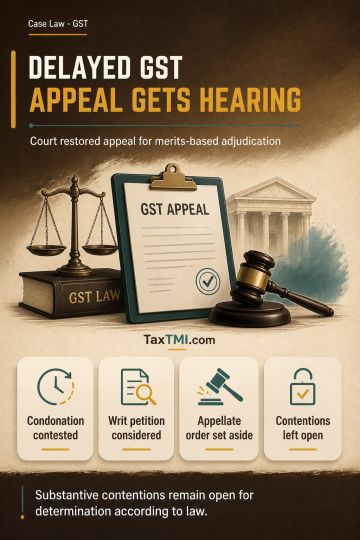
Necessary-party requirements limit impleadment of independent entities, while deferred consideration does not create an appealable adverse determinati...
Food supplement classification requires common parlance and authoritative tests, preventing treatment as proprietary Ayurvedic medicines without suppo...
Specified regulatory authority income receives conditional tax exemption, subject to non-commercial activity, unchanged income character, and return f...
Tax exemption for regulatory authority income applies retrospectively, subject to non-commercial activity, unchanged income sources, and return-filing...
Input tax credit conditions remain constitutionally valid, with eligible recipient claims considered under GST circulars and retrospective filing dead...
Classification of services provided by Grant Thornton, India to develop the "Grant Thornton" brand name and the payment received towards reimbursement of "Brand Development Expenses". It examines whether these services constitute business auxiliary services or intermediary services, and whether they qualify as export of services. The Tribunal held that Grant Thornton, India was not acting as an intermediary but providing services on its own account for promoting the brand in India. The transaction did not fall under the intermediary services rule, and the place of provision was the location of the recipient, Grant Thornton, London, outside India. As payment was received in convertible foreign currency, the conditions for export of services were satisfied. The Tribunal relied on previous decisions clarifying the meaning of intermediary services and the scope of export of services. It concluded that Grant Thornton, India was not an intermediary, and the services provided to Grant Thornton, London constituted export of services, dismissing the appeal against the order dropping the proceedings.
Classification of services provided by Grant Thornton, India to develop the "Grant Thornton" brand name and the payment received towards reimbursement of "Brand Development Expenses". It examines whether these services constitute business auxiliary services or intermediary services, and whether they qualify as export of services. The Tribunal held that Grant Thornton, India was not acting as an intermediary but providing services on its own account for promoting the brand in India. The transaction did not fall under the intermediary services rule, and the place of provision was the location of the recipient, Grant Thornton, London, outside India. As payment was received in convertible foreign currency, the conditions for export of services were satisfied. The Tribunal relied on previous decisions clarifying the meaning of intermediary services and the scope of export of services. It concluded that Grant Thornton, India was not an intermediary, and the services provided to Grant Thornton, London constituted export of services, dismissing the appeal against the order dropping the proceedings.
Note: It is a system-generated summary and is for quick reference only.
 TaxTMI
 of 4792
















 Join Channel


 TaxTMI