Inherited property sale proceeds require capital-gains treatment where ownership is supported by evidence, not suspicion or unverified signature doubt...
Cross-examination of retracted statements is essential where foundational evidence supports a benami allegation and documented funding explanations re...
Capital-goods exemption covers plant-modernisation accessories, while the import restriction applies only to earlier capital-goods components and spar...
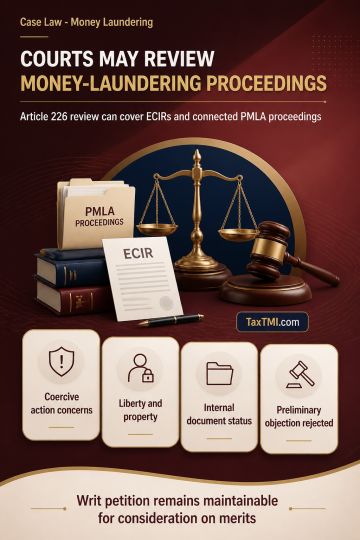
Constitutional judicial review permits challenges to ECIRs and connected money-laundering proceedings where coercive action affects fundamental intere...
The appellant, engaged in manufacturing SS Hose Assembly, Flange & Fittings, also procured MS Round, TMT Bars, etc., performed work on them, and cleared them to buyers after availing CENVAT credit on inputs. The entire CENVAT credit was reversed upon clearance to buyers. The demand of Rs. 1,46,75,425/- towards CENVAT credit and u/s 11D indicates the credit was properly reversed. The goods' clearance falls u/r 3(5) of CCR, 2004 rather than finished goods clearance. The appellant provided documentary evidence of receiving goods, accounting in books, and banking channel payments. The CESTAT held that denying CENVAT credit was unjustified. Regarding time limitation, the show cause notice was issued belatedly in 2013 for transactions during 2008-10, which were part of ER-1 returns relied upon. No suppression was established, making the demand time-barred. The appeals were allowed on merits and time bar.
The appellant, engaged in manufacturing SS Hose Assembly, Flange & Fittings, also procured MS Round, TMT Bars, etc., performed work on them, and cleared them to buyers after availing CENVAT credit on inputs. The entire CENVAT credit was reversed upon clearance to buyers. The demand of Rs. 1,46,75,425/- towards CENVAT credit and u/s 11D indicates the credit was properly reversed. The goods' clearance falls u/r 3(5) of CCR, 2004 rather than finished goods clearance. The appellant provided documentary evidence of receiving goods, accounting in books, and banking channel payments. The CESTAT held that denying CENVAT credit was unjustified. Regarding time limitation, the show cause notice was issued belatedly in 2013 for transactions during 2008-10, which were part of ER-1 returns relied upon. No suppression was established, making the demand time-barred. The appeals were allowed on merits and time bar.
Note: It is a system-generated summary and is for quick reference only.
 TaxTMI
 of 4784













 Join Channel


 TaxTMI