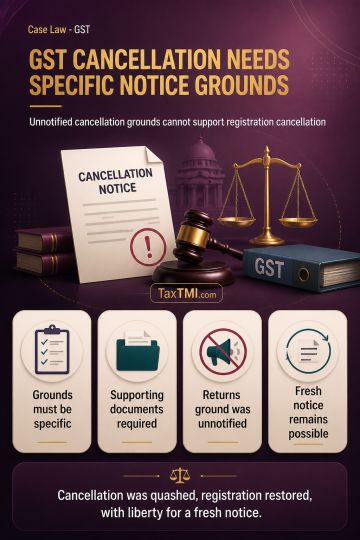
Clean slate principle extinguishes uncrystallised operational claims and bars continuation of pending recovery and arbitral proceedings after plan app...
Works contract classification governs composite layout-development contracts where VAT-paid goods are transferred alongside construction and infrastru...
Specified income tax exemption for pollution control body remains conditional on non-commercial activity, unchanged income character, and return filin...
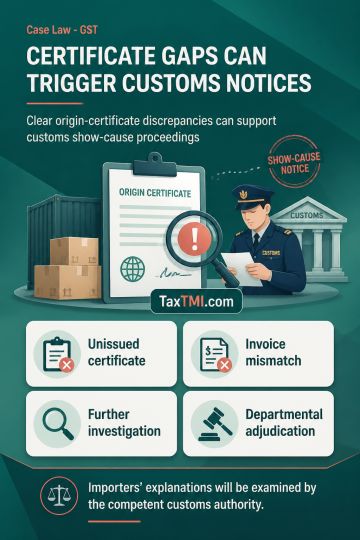
Jurisdictional facts in certificate-of-origin discrepancies can support customs show-cause proceedings, leaving factual explanations for departmental ...
The appellant, engaged in manufacturing SS Hose Assembly, Flange & Fittings, also procured MS Round, TMT Bars, etc., performed work on them, and cleared them to buyers after availing CENVAT credit on inputs. The entire CENVAT credit was reversed upon clearance to buyers. The demand of Rs. 1,46,75,425/- towards CENVAT credit and u/s 11D indicates the credit was properly reversed. The goods' clearance falls u/r 3(5) of CCR, 2004 rather than finished goods clearance. The appellant provided documentary evidence of receiving goods, accounting in books, and banking channel payments. The CESTAT held that denying CENVAT credit was unjustified. Regarding time limitation, the show cause notice was issued belatedly in 2013 for transactions during 2008-10, which were part of ER-1 returns relied upon. No suppression was established, making the demand time-barred. The appeals were allowed on merits and time bar.
The appellant, engaged in manufacturing SS Hose Assembly, Flange & Fittings, also procured MS Round, TMT Bars, etc., performed work on them, and cleared them to buyers after availing CENVAT credit on inputs. The entire CENVAT credit was reversed upon clearance to buyers. The demand of Rs. 1,46,75,425/- towards CENVAT credit and u/s 11D indicates the credit was properly reversed. The goods' clearance falls u/r 3(5) of CCR, 2004 rather than finished goods clearance. The appellant provided documentary evidence of receiving goods, accounting in books, and banking channel payments. The CESTAT held that denying CENVAT credit was unjustified. Regarding time limitation, the show cause notice was issued belatedly in 2013 for transactions during 2008-10, which were part of ER-1 returns relied upon. No suppression was established, making the demand time-barred. The appeals were allowed on merits and time bar.
Note: It is a system-generated summary and is for quick reference only.
 TaxTMI
 of 4796














 Join Channel


 TaxTMI