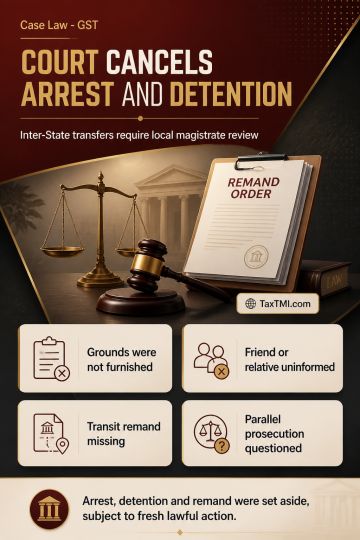
Arrest safeguards and transit remand requirements invalidated detention following inter-State transfer without communicated grounds or magistrate auth...
Arrest safeguards require disclosed grounds, relative intimation and transit remand, while duplicate prosecution under the CGST framework is unsustain...
Document Identification Number defects can invalidate GST assessments, with delayed challenges entertained conditionally where patent irregularities e...
Windmill commissioning evidence supported higher depreciation where grid connection and electricity generation proved operational use before the relev...
Pharmaceutical promotion and transfer-pricing comparability principles limited disallowances, while uncorroborated search allegations and unsupported ...
Business expenditure substantiation supports scrap credits, statutory payments and expense claims, while depreciation requires proof of actual busines...
The appellant, engaged in manufacturing SS Hose Assembly, Flange & Fittings, also procured MS Round, TMT Bars, etc., performed work on them, and cleared them to buyers after availing CENVAT credit on inputs. The entire CENVAT credit was reversed upon clearance to buyers. The demand of Rs. 1,46,75,425/- towards CENVAT credit and u/s 11D indicates the credit was properly reversed. The goods' clearance falls u/r 3(5) of CCR, 2004 rather than finished goods clearance. The appellant provided documentary evidence of receiving goods, accounting in books, and banking channel payments. The CESTAT held that denying CENVAT credit was unjustified. Regarding time limitation, the show cause notice was issued belatedly in 2013 for transactions during 2008-10, which were part of ER-1 returns relied upon. No suppression was established, making the demand time-barred. The appeals were allowed on merits and time bar.
The appellant, engaged in manufacturing SS Hose Assembly, Flange & Fittings, also procured MS Round, TMT Bars, etc., performed work on them, and cleared them to buyers after availing CENVAT credit on inputs. The entire CENVAT credit was reversed upon clearance to buyers. The demand of Rs. 1,46,75,425/- towards CENVAT credit and u/s 11D indicates the credit was properly reversed. The goods' clearance falls u/r 3(5) of CCR, 2004 rather than finished goods clearance. The appellant provided documentary evidence of receiving goods, accounting in books, and banking channel payments. The CESTAT held that denying CENVAT credit was unjustified. Regarding time limitation, the show cause notice was issued belatedly in 2013 for transactions during 2008-10, which were part of ER-1 returns relied upon. No suppression was established, making the demand time-barred. The appeals were allowed on merits and time bar.
Note: It is a system-generated summary and is for quick reference only.
 TaxTMI
 of 4792




















 Join Channel


 TaxTMI