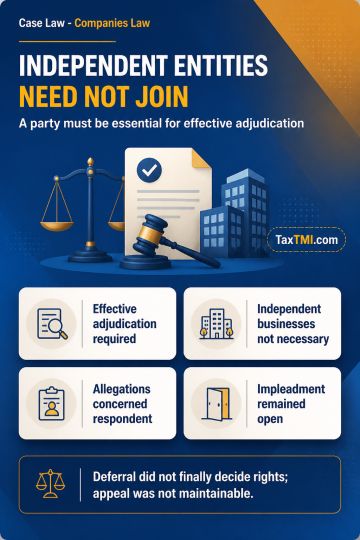
Necessary-party requirements limit impleadment of independent entities, while deferred consideration does not create an appealable adverse determinati...
Food supplement classification requires common parlance and authoritative tests, preventing treatment as proprietary Ayurvedic medicines without suppo...
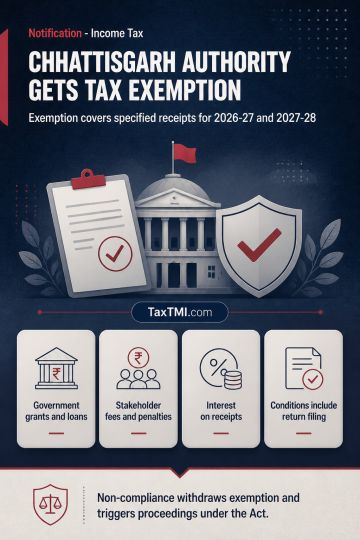
Specified regulatory authority income receives conditional tax exemption, subject to non-commercial activity, unchanged income character, and return f...
Tax exemption for regulatory authority income applies retrospectively, subject to non-commercial activity, unchanged income sources, and return-filing...
Input tax credit conditions remain constitutionally valid, with eligible recipient claims considered under GST circulars and retrospective filing dead...
The appellant, engaged in manufacturing SS Hose Assembly, Flange & Fittings, also procured MS Round, TMT Bars, etc., performed work on them, and cleared them to buyers after availing CENVAT credit on inputs. The entire CENVAT credit was reversed upon clearance to buyers. The demand of Rs. 1,46,75,425/- towards CENVAT credit and u/s 11D indicates the credit was properly reversed. The goods' clearance falls u/r 3(5) of CCR, 2004 rather than finished goods clearance. The appellant provided documentary evidence of receiving goods, accounting in books, and banking channel payments. The CESTAT held that denying CENVAT credit was unjustified. Regarding time limitation, the show cause notice was issued belatedly in 2013 for transactions during 2008-10, which were part of ER-1 returns relied upon. No suppression was established, making the demand time-barred. The appeals were allowed on merits and time bar.
The appellant, engaged in manufacturing SS Hose Assembly, Flange & Fittings, also procured MS Round, TMT Bars, etc., performed work on them, and cleared them to buyers after availing CENVAT credit on inputs. The entire CENVAT credit was reversed upon clearance to buyers. The demand of Rs. 1,46,75,425/- towards CENVAT credit and u/s 11D indicates the credit was properly reversed. The goods' clearance falls u/r 3(5) of CCR, 2004 rather than finished goods clearance. The appellant provided documentary evidence of receiving goods, accounting in books, and banking channel payments. The CESTAT held that denying CENVAT credit was unjustified. Regarding time limitation, the show cause notice was issued belatedly in 2013 for transactions during 2008-10, which were part of ER-1 returns relied upon. No suppression was established, making the demand time-barred. The appeals were allowed on merits and time bar.
Note: It is a system-generated summary and is for quick reference only.
 TaxTMI
 of 4792

















 Join Channel


 TaxTMI

