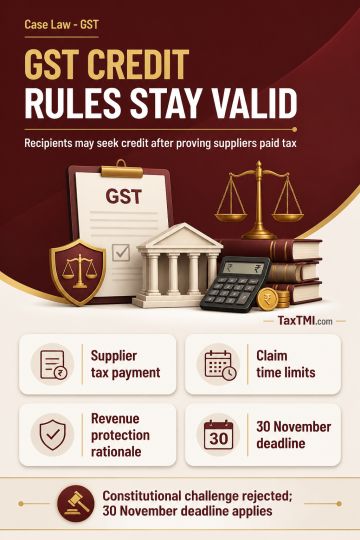
Input tax credit conditions remain constitutionally valid, with eligible recipient claims considered under GST circulars and retrospective filing dead...
Bogus donation receipts justified commission income assessment and defeated political-party tax exemption for inaccurate accounts and reporting failur...
Pure reimbursement without income element escapes tax withholding, while delayed withholding and unsupported provisions face deferred or renewed scrut...
Public benefit requirement defeats charitable registration where residents' association services are reciprocal, member-only facilities governed by mu...
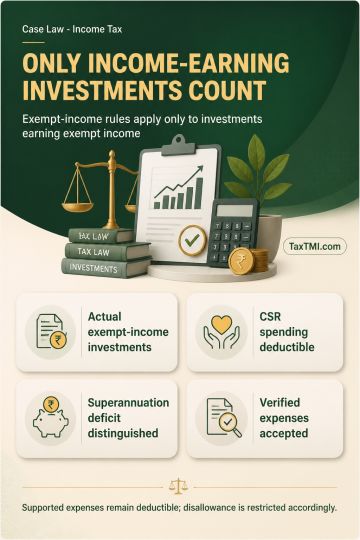
Exempt-income expenditure disallowance is confined to investments that actually generated exempt income, while supported business expenses remain dedu...
Page of 4790
Press 'Enter' after typing page number.
501 to 520 of 95798 Results
❮
❯
❯❯
0 / 200
Expand Note
Add to Folder
No Folders have been created
+
Are you sure you want to delete "My most important" ?
Acquittal of the accused in a cheque dishonor case. The court observed that once the accused raises a probable defense by leading evidence to show no debt/liability existed, the presumptions u/ss 118 and 139 of the Negotiable Instruments Act disappear. The burden then shifts to the complainant to prove the existence of debt as a matter of fact. In this case, the accused denied issuing the cheque and his signatures. Expert opinion was obtained, and the trial court found the complainant failed to prove the debt/liability's existence, mode of loan advancement, or documentary evidence. The high court found no perversity in the acquittal order, dismissing the petition challenging the acquittal.
Acquittal of the accused in a cheque dishonor case. The court observed that once the accused raises a probable defense by leading evidence to show no debt/liability existed, the presumptions u/ss 118 and 139 of the Negotiable Instruments Act disappear. The burden then shifts to the complainant to prove the existence of debt as a matter of fact. In this case, the accused denied issuing the cheque and his signatures. Expert opinion was obtained, and the trial court found the complainant failed to prove the debt/liability's existence, mode of loan advancement, or documentary evidence. The high court found no perversity in the acquittal order, dismissing the petition challenging the acquittal.
Note: It is a system-generated summary and is for quick reference only.
 TaxTMI
 of 4790

















 Join Channel


 TaxTMI