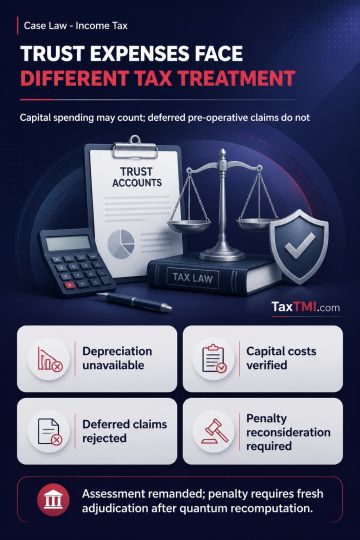
Charitable trust income application permits verified capital expenditure but rejects deferred pre-operative claims and requires reconsideration of con...
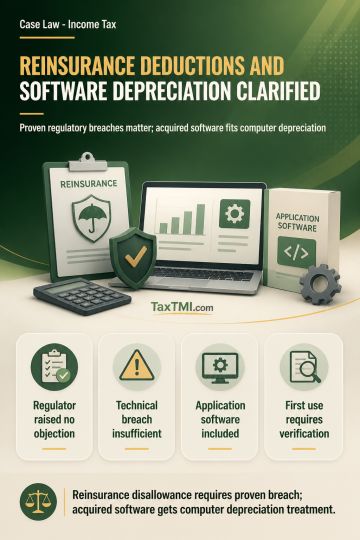
Reinsurance premium deductions require established regulatory breaches, while independently acquired software qualifies within the computer depreciati...
Rectification of mistake remains limited to self-evident record errors, preventing merits review through miscellaneous applications and preserving fin...
Tender creditworthiness conditions may extend to de facto Promoter Directors, with post-participation challenges generally barred absent arbitrariness...
Corporate representation in PMLA summons proceedings permitted through an authorised signatory, subject to directors' continuing cooperation and atten...
Page of 4801
Press 'Enter' after typing page number.
861 to 880 of 96001 Results
❮
❯
❯❯
0 / 200
Expand Note
Add to Folder
No Folders have been created
+
Are you sure you want to delete "My most important" ?
This document provides guidance on compounding of contraventions under the Foreign Exchange Management Act (FEMA), 1999. It outlines the process, eligibility criteria, and computation matrix for determining the compounding amount payable for various types of contraventions. Key points: - Certain contraventions related to foreign investment, external commercial borrowings, overseas investment, and branch/liaison offices can be compounded by RBI's Regional Offices. - Applicants must submit a compounding application along with the prescribed fee of Rs. 10,000 plus GST. - Cases involving serious contraventions like money laundering, terror financing, or affecting national sovereignty are not eligible for compounding. - The compounding amount is calculated based on factors such as the sum involved, duration of contravention, undue gains made, and repetitive nature of the contravention. - A detailed computation matrix with formulas is provided for calculating the compounding amount for different types of contraventions. - The compounding authority will pass an order after giving the applicant an opportunity for a personal hearing. - The compounded amount must be paid within 15 days from the date of the compounding order. - Summary information about compounding orders will be hosted on RBI's website. The document also covers procedural aspects like submission of applications, payment modes, and issuance of compounding orders.
This document provides guidance on compounding of contraventions under the Foreign Exchange Management Act (FEMA), 1999. It outlines the process, eligibility criteria, and computation matrix for determining the compounding amount payable for various types of contraventions. Key points: - Certain contraventions related to foreign investment, external commercial borrowings, overseas investment, and branch/liaison offices can be compounded by RBI's Regional Offices. - Applicants must submit a compounding application along with the prescribed fee of Rs. 10,000 plus GST. - Cases involving serious contraventions like money laundering, terror financing, or affecting national sovereignty are not eligible for compounding. - The compounding amount is calculated based on factors such as the sum involved, duration of contravention, undue gains made, and repetitive nature of the contravention. - A detailed computation matrix with formulas is provided for calculating the compounding amount for different types of contraventions. - The compounding authority will pass an order after giving the applicant an opportunity for a personal hearing. - The compounded amount must be paid within 15 days from the date of the compounding order. - Summary information about compounding orders will be hosted on RBI's website. The document also covers procedural aspects like submission of applications, payment modes, and issuance of compounding orders.
Note: It is a system-generated summary and is for quick reference only.
 TaxTMI
 of 4801














 Join Channel


 TaxTMI
