Retention of seized property survives where recorded reasons support proceeds of crime, while stayed investigation periods are excluded from limitatio...
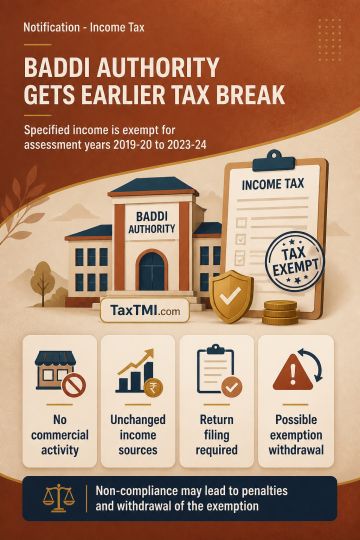
Specified income of Baddi Barotiwala Nalagarh Development Authority receives conditional tax exemption, retrospectively covering its designated assess...
Specified development authority income receives retrospective tax exemption, subject to non-commercial activity, unchanged income sources, and return-...
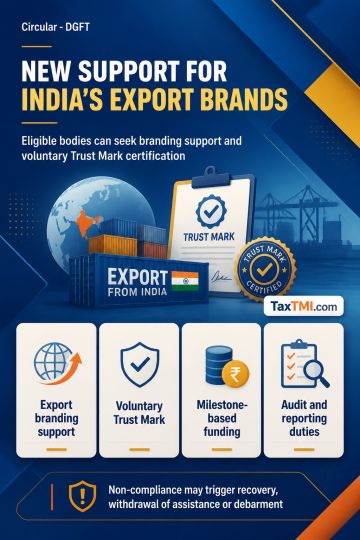
Unified Brand India framework introduces voluntary Trust Mark certification and funding support for export branding, packaging and global promotional ...
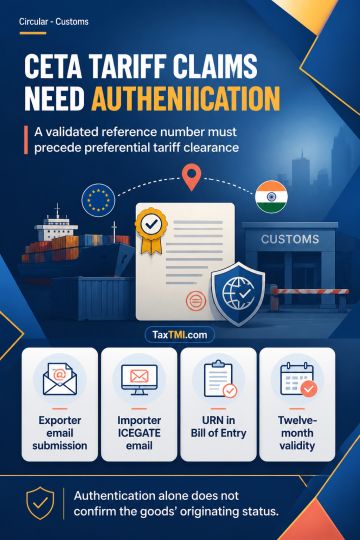
Origin Declaration authentication governs preferential tariff claims under India-UK CETA, requiring a validated reference number before import clearan...
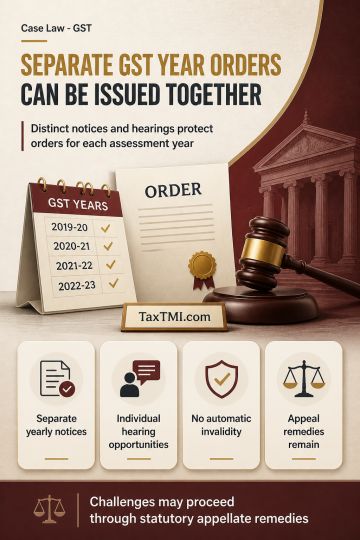
Separate assessment orders for different years remain valid when distinct notices and hearing opportunities prevent prejudice from combined proceeding...
The High Court upheld the validity of the impugned order u/s 107(11) of the Karnataka Goods and Services Act, 2017. The petitioner's contention that the adjudicating authority erred by not taking action against the supplier and ignoring tax invoices and tax payments was rejected. The court held that the purchasing dealer must prove the actual physical movement of goods unless purchased from respective dealers. Failure to establish this aspect justifies rejection of Input Tax Credit (ITC) claims by the assessing officer, as per the Supreme Court's judgment in The State of Karnataka v. M/s Ecom Gill Coffee Trading Private Limited. Although the petitioner produced documents showing the supplier's existence and business continuity, the vehicles transporting the goods were not traced and appeared fraudulent. Section 16(2)(c)(d) was applicable, and the burden of proving ITC eligibility lies on the purchaser u/s 155. The revenue can recover tax from the purchaser if the supplier failed to pay. The appellate authority rightly confirmed the order rejecting the petitioner's ITC claim. The High Court found no malice, arbitrariness, or illegality in the order and dismissed the writ petition.
The High Court upheld the validity of the impugned order u/s 107(11) of the Karnataka Goods and Services Act, 2017. The petitioner's contention that the adjudicating authority erred by not taking action against the supplier and ignoring tax invoices and tax payments was rejected. The court held that the purchasing dealer must prove the actual physical movement of goods unless purchased from respective dealers. Failure to establish this aspect justifies rejection of Input Tax Credit (ITC) claims by the assessing officer, as per the Supreme Court's judgment in The State of Karnataka v. M/s Ecom Gill Coffee Trading Private Limited. Although the petitioner produced documents showing the supplier's existence and business continuity, the vehicles transporting the goods were not traced and appeared fraudulent. Section 16(2)(c)(d) was applicable, and the burden of proving ITC eligibility lies on the purchaser u/s 155. The revenue can recover tax from the purchaser if the supplier failed to pay. The appellate authority rightly confirmed the order rejecting the petitioner's ITC claim. The High Court found no malice, arbitrariness, or illegality in the order and dismissed the writ petition.
Note: It is a system-generated summary and is for quick reference only.
 TaxTMI
 of 4805








 Join Channel


 TaxTMI
