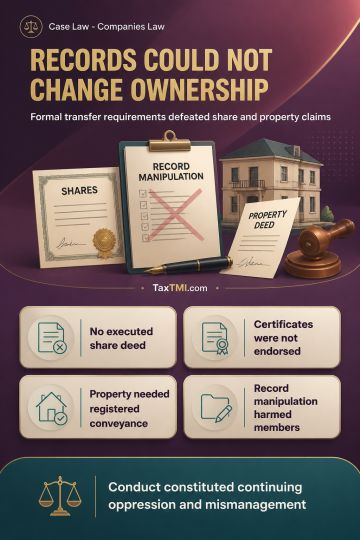
Statutory transfer formalities invalidated alleged share and property transfers, while retrospective record manipulation constituted oppression and mi...
Provisional attachment of laundered funds and equivalent-value property sustained, with statutory protection limited to pension, gratuity and providen...
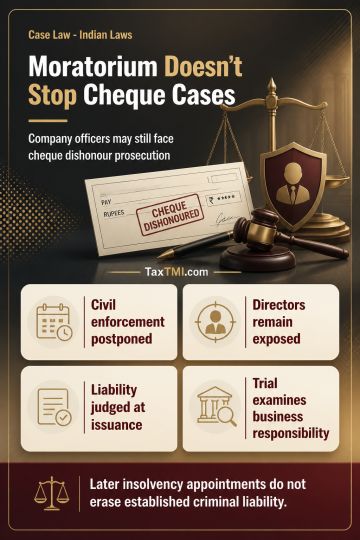
Insolvency moratorium does not shield company officers from cheque dishonour prosecution for liability arising before corporate insolvency proceedings...
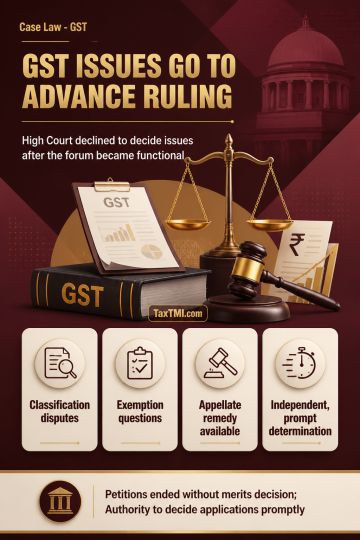
Advance-ruling mechanism governs pending GST classification, exemption and taxability disputes, limiting writ review once the specialised forum functi...
Page of 4805
Press 'Enter' after typing page number.
921 to 940 of 96092 Results
❮
❯
❯❯
0 / 200
Expand Note
Add to Folder
No Folders have been created
+
Are you sure you want to delete "My most important" ?
The High Court upheld the validity of the impugned order u/s 107(11) of the Karnataka Goods and Services Act, 2017. The petitioner's contention that the adjudicating authority erred by not taking action against the supplier and ignoring tax invoices and tax payments was rejected. The court held that the purchasing dealer must prove the actual physical movement of goods unless purchased from respective dealers. Failure to establish this aspect justifies rejection of Input Tax Credit (ITC) claims by the assessing officer, as per the Supreme Court's judgment in The State of Karnataka v. M/s Ecom Gill Coffee Trading Private Limited. Although the petitioner produced documents showing the supplier's existence and business continuity, the vehicles transporting the goods were not traced and appeared fraudulent. Section 16(2)(c)(d) was applicable, and the burden of proving ITC eligibility lies on the purchaser u/s 155. The revenue can recover tax from the purchaser if the supplier failed to pay. The appellate authority rightly confirmed the order rejecting the petitioner's ITC claim. The High Court found no malice, arbitrariness, or illegality in the order and dismissed the writ petition.
The High Court upheld the validity of the impugned order u/s 107(11) of the Karnataka Goods and Services Act, 2017. The petitioner's contention that the adjudicating authority erred by not taking action against the supplier and ignoring tax invoices and tax payments was rejected. The court held that the purchasing dealer must prove the actual physical movement of goods unless purchased from respective dealers. Failure to establish this aspect justifies rejection of Input Tax Credit (ITC) claims by the assessing officer, as per the Supreme Court's judgment in The State of Karnataka v. M/s Ecom Gill Coffee Trading Private Limited. Although the petitioner produced documents showing the supplier's existence and business continuity, the vehicles transporting the goods were not traced and appeared fraudulent. Section 16(2)(c)(d) was applicable, and the burden of proving ITC eligibility lies on the purchaser u/s 155. The revenue can recover tax from the purchaser if the supplier failed to pay. The appellate authority rightly confirmed the order rejecting the petitioner's ITC claim. The High Court found no malice, arbitrariness, or illegality in the order and dismissed the writ petition.
Note: It is a system-generated summary and is for quick reference only.
 TaxTMI
 of 4805







 Join Channel


 TaxTMI