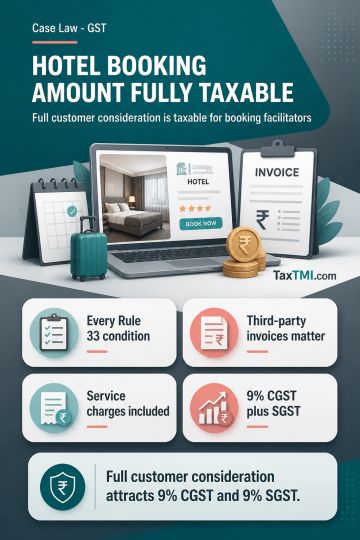
Pure-agent exclusion fails where hotel booking facilitators receive third-party services themselves, making entire customer consideration taxable as r...
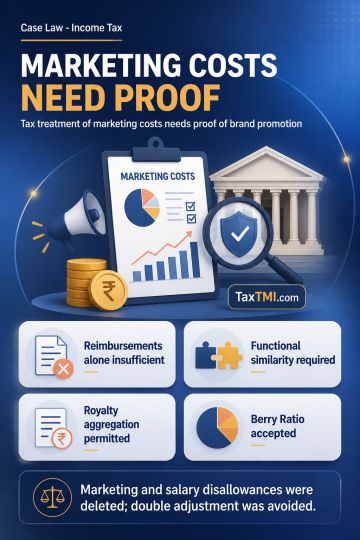
Transfer pricing requires evidence for AMP transactions, functionally reliable comparables, and appropriate aggregation or Berry Ratio benchmarking me...
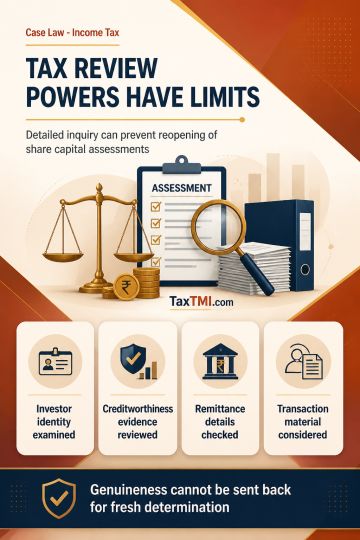
Revisionary jurisdiction cannot reopen share capital assessments where adequate inquiry supports a permissible view and no independent error is establ...
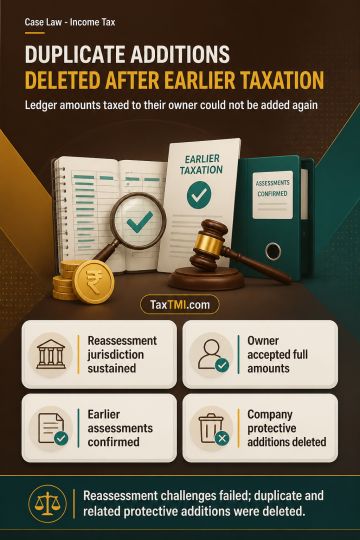
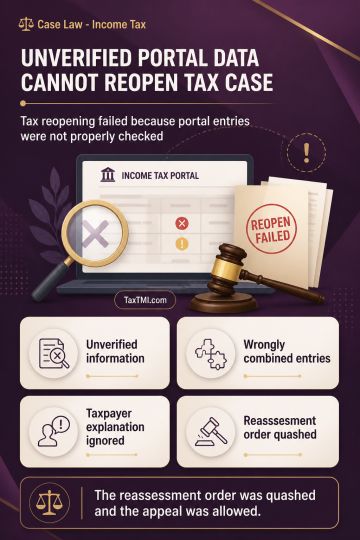
Reassessment jurisdiction fails where unverified portal information is aggregated without examining the taxpayer's explanation or relevance of entries...
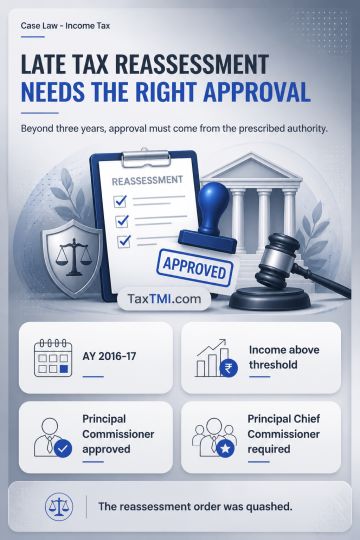
Statutory sanction for delayed reassessment requires approval from the prescribed authority; approval by an inferior authority invalidates jurisdictio...
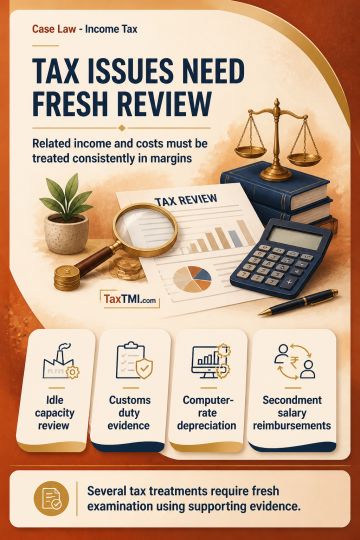
Transfer pricing margin adjustments require matching treatment of non-operating income and related costs, with comparability issues reconsidered on ev...
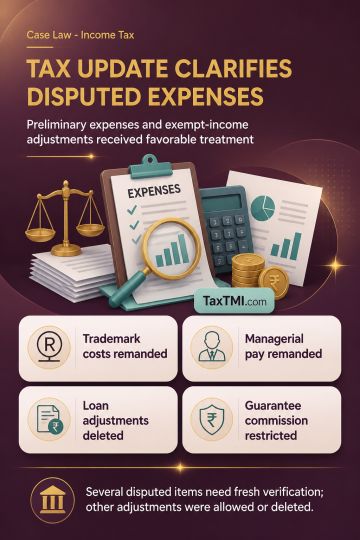
Preliminary-expense amortisation and MAT exempt-income adjustments prevailed, while trademark costs and managerial remuneration require fresh verifica...
Export valuation requires contemporaneous evidence; unrelated invoices cannot prove overvaluation, and dual penalties on firm and partner are impermis...
Page of 4824
Press 'Enter' after typing page number.
601 to 620 of 96463 Results
❮
❯
❯❯
0 / 200
Expand Note
Add to Folder
No Folders have been created
+
Are you sure you want to delete "My most important" ?
The case pertains to the assumption of jurisdiction u/ss 147/148 read with section 151 of the Income Tax Act. The Assessing Officer (AO) wrongly assumed jurisdiction u/s 147 instead of the statutory path available u/s 153C. The case was reopened beyond the period of four years based on information received from the Investigation Wing, New Delhi, alleging bogus Long-Term Capital Gains (LTCG) and addition u/s 68 on account of share capital treated as an accommodation entry. The Tribunal held that the AO's reluctance to initiate reopening proceedings based on generalized and uncorroborated information, and the issuance of notice u/s 148 on the last day, implying compulsion to save on limitation, demonstrated a lack of independent inquiry and application of mind. The financial year was wrongly mentioned, approval was granted by the PCIT based on an incomplete Performa, and the satisfaction of the Additional CIT that the 'case requires verification' did not meet the requirement of 'chargeable income has escaped assessment' u/s 148. The Tribunal found overwhelming reasons that the reasons recorded and approval granted u/s 151 did not meet legal requirements. The issuance of notice u/s 148 based on cryptic reasons and mechanical approval by the Pr.CIT u/s 151 did not pass.
The case pertains to the assumption of jurisdiction u/ss 147/148 read with section 151 of the Income Tax Act. The Assessing Officer (AO) wrongly assumed jurisdiction u/s 147 instead of the statutory path available u/s 153C. The case was reopened beyond the period of four years based on information received from the Investigation Wing, New Delhi, alleging bogus Long-Term Capital Gains (LTCG) and addition u/s 68 on account of share capital treated as an accommodation entry. The Tribunal held that the AO's reluctance to initiate reopening proceedings based on generalized and uncorroborated information, and the issuance of notice u/s 148 on the last day, implying compulsion to save on limitation, demonstrated a lack of independent inquiry and application of mind. The financial year was wrongly mentioned, approval was granted by the PCIT based on an incomplete Performa, and the satisfaction of the Additional CIT that the 'case requires verification' did not meet the requirement of 'chargeable income has escaped assessment' u/s 148. The Tribunal found overwhelming reasons that the reasons recorded and approval granted u/s 151 did not meet legal requirements. The issuance of notice u/s 148 based on cryptic reasons and mechanical approval by the Pr.CIT u/s 151 did not pass.
Note: It is a system-generated summary and is for quick reference only.
 TaxTMI
  TaxTMI
 of 4824











 Join Channel