Charitable registration renewal cannot become an assessment of receipts, profitability or annual exemption compliance, requiring renewal and donation ...
AMP expenditure for own business is not an international transaction without an associated-enterprise arrangement, eliminating transfer pricing adjust...
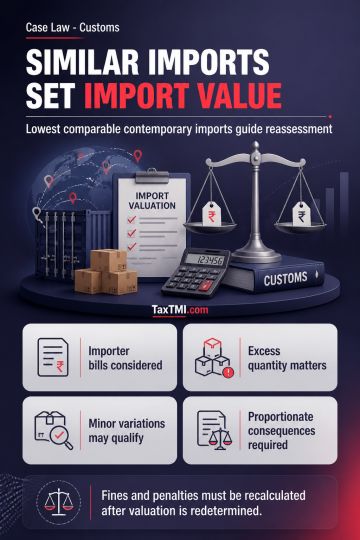
Customs valuation must use comparable contemporary imports, while confiscation fines and penalties require proportionate recalculation on reassessed v...
Depositor-protection proceedings prevail over corporate insolvency, while liquidators may recover chit receivables using copies of seized company reco...
Intermediary service classification fails where overseas admission facilitation is supplied independently, preserving export treatment and small-provi...
Satellite transponder bandwidth is telecommunication, not Business Support Service; foreign non-telegraph providers triggered no service tax liability...
Page of 4824
Press 'Enter' after typing page number.
441 to 460 of 96463 Results
❮
❯
❯❯
0 / 200
Expand Note
Add to Folder
No Folders have been created
+
Are you sure you want to delete "My most important" ?
The Tamil Nadu Protection of Interests of Depositors Act (TNPID Act), 1997, is a special enactment intended to protect depositors' rights and provide a mechanism for disbursement of assets of the accused, apart from punishing them. The Insolvency and Bankruptcy Code (IBC), 2016, overrides inconsistent provisions in other laws, as per Section 238. However, the Madras High Court held that the TNPID Act's purpose, upheld by the Supreme Court despite marginal encroachment into Central legislations, cannot be ignored. The Court ruled that the NCLT order declaring attachments under the TNPID Act null and void was contrary to settled principles of law. The State's sovereign power and duty to protect public interest through the TNPID Act was reiterated, allowing the petition.
The Tamil Nadu Protection of Interests of Depositors Act (TNPID Act), 1997, is a special enactment intended to protect depositors' rights and provide a mechanism for disbursement of assets of the accused, apart from punishing them. The Insolvency and Bankruptcy Code (IBC), 2016, overrides inconsistent provisions in other laws, as per Section 238. However, the Madras High Court held that the TNPID Act's purpose, upheld by the Supreme Court despite marginal encroachment into Central legislations, cannot be ignored. The Court ruled that the NCLT order declaring attachments under the TNPID Act null and void was contrary to settled principles of law. The State's sovereign power and duty to protect public interest through the TNPID Act was reiterated, allowing the petition.
Note: It is a system-generated summary and is for quick reference only.
 TaxTMI
  TaxTMI
 of 4824




















 Join Channel


