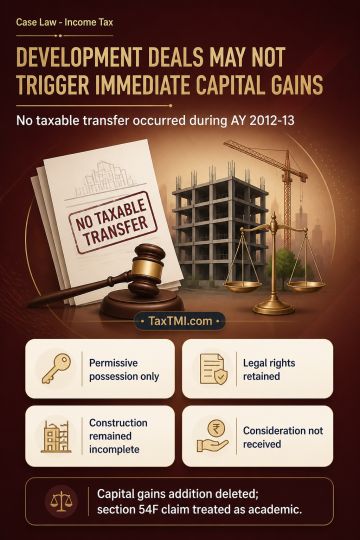
Development agreements require legal possession or effective enjoyment for capital gains transfer; permissive possession and deferred consideration de...
Prolonged sterilisation of development rights supports capital-gains treatment, while business-income disallowances cannot govern capital-gains comput...
Additional evidence in transfer pricing dispute leads to fresh examination, while tax deductions, TDS credit, fee and refund interest require verifica...
Category II AIF pass-through taxation preserves non-business income character; investment receipts cannot be reclassified without applying recognised ...
Mutual fund maturity rules require proper rollover, redemption, disclosure, and due diligence; investor gains cannot excuse regulatory breaches or pen...
Loose papers found during a search at the residences of individuals contained notings and calculations presumed by the Assessing Officer (AO) to relate to undisclosed income and investments of one individual. However, the evidence failed to establish any connection between the notings and that individual's activities or sources of income. The notings pertained to expenses, vehicle purchases, and numerical entries, but no regular income was identified for that person to correlate with such expenses. The loose papers were found at another individual's residence, whose business records were accepted. The Tribunal held that the AO wrongly attributed the loose paper notings to the first individual without establishing any link or means of income, when they likely related to the second individual's accepted business. Consequently, the additions made by the AO based on the loose papers were deleted for lack of credible evidence connecting them to the first individual's undisclosed income or investments.
Loose papers found during a search at the residences of individuals contained notings and calculations presumed by the Assessing Officer (AO) to relate to undisclosed income and investments of one individual. However, the evidence failed to establish any connection between the notings and that individual's activities or sources of income. The notings pertained to expenses, vehicle purchases, and numerical entries, but no regular income was identified for that person to correlate with such expenses. The loose papers were found at another individual's residence, whose business records were accepted. The Tribunal held that the AO wrongly attributed the loose paper notings to the first individual without establishing any link or means of income, when they likely related to the second individual's accepted business. Consequently, the additions made by the AO based on the loose papers were deleted for lack of credible evidence connecting them to the first individual's undisclosed income or investments.
Note: It is a system-generated summary and is for quick reference only.
 TaxTMI
  TaxTMI
 of 4809














 Join Channel