Captive power transfer pricing and non-resident export commission rules support deletion of adjustments and withholding disallowance in discussed proc...
Cooperative society deposits, member-interest TDS exemption and credit-facility deduction claims require verification through records and supporting e...
Customs jurisdiction over EPCG condition breaches survives export-obligation discharge certificates, requiring alleged fraud and misdeclaration to be ...
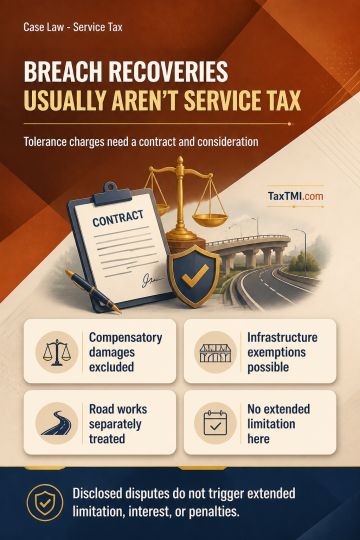
Contractual tolerance requires consideration; breach recoveries, qualifying public infrastructure services and road works escape service tax liability...
The assessee borrowed loans from financial institutions at an interest rate of 12.75% and advanced loans to group companies or relatives at 12% interest rate. The assessee restricted the claim of interest expense u/s 57 to 12%, being the interest earned. The Principal Commissioner of Income Tax (PCIT) invoked revision u/s 263, disallowing the interest income, concluding the assessee failed to substantiate the nexus between the interest-bearing loans taken and advances made. The PCIT also held the Assessing Officer (AO) wrongly added unexplained cash credits to income without considering the assessee's submissions. The Income Tax Appellate Tribunal (ITAT) observed the assessee disclosed rental income correctly. Relying on the Supreme Court's decision in Malabar Industrial Co. Ltd., the ITAT held the PCIT failed to demonstrate the AO's order was erroneous due to inadequate inquiry. The AO conducted necessary inquiries and applied his mind. No prejudice was caused to the Revenue. The PCIT's order was unsustainable in law, and the assessee's appeal was allowed.
The assessee borrowed loans from financial institutions at an interest rate of 12.75% and advanced loans to group companies or relatives at 12% interest rate. The assessee restricted the claim of interest expense u/s 57 to 12%, being the interest earned. The Principal Commissioner of Income Tax (PCIT) invoked revision u/s 263, disallowing the interest income, concluding the assessee failed to substantiate the nexus between the interest-bearing loans taken and advances made. The PCIT also held the Assessing Officer (AO) wrongly added unexplained cash credits to income without considering the assessee's submissions. The Income Tax Appellate Tribunal (ITAT) observed the assessee disclosed rental income correctly. Relying on the Supreme Court's decision in Malabar Industrial Co. Ltd., the ITAT held the PCIT failed to demonstrate the AO's order was erroneous due to inadequate inquiry. The AO conducted necessary inquiries and applied his mind. No prejudice was caused to the Revenue. The PCIT's order was unsustainable in law, and the assessee's appeal was allowed.
Note: It is a system-generated summary and is for quick reference only.
 TaxTMI
 of 4805


















 Join Channel


 TaxTMI
