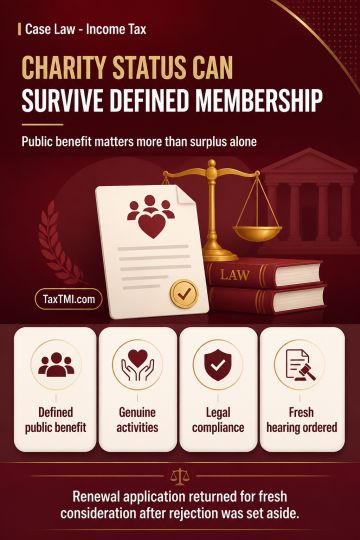
Defined public benefit can retain charitable character; registration renewal requires examining genuine activities and legal compliance, not surplus a...
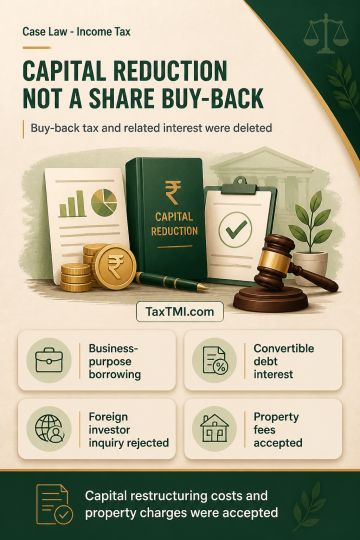
Capital reduction is distinct from share buy-back, preventing buy-back tax; restructuring interest and related business deductions also survive scruti...
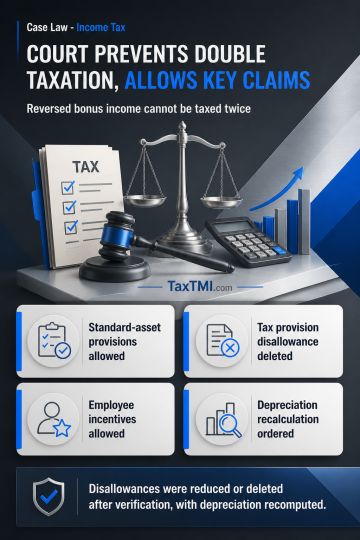
Transfer pricing and tax deductions upheld on established principles, while employee contributions and warranty provisions returned for fresh examinat...
Captive transfer pricing relies on industrial consumer tariffs, while genuine quotations can benchmark effluent treatment transfers under the Other Me...
Specific tariff classification for ophthalmic instruments and extended limitation principles determine the treatment of duty demands, confiscation, an...
Service tax liability cannot be imposed twice on the same transaction. The appellant, as a service recipient, was required to pay 75% of the service tax under the reverse charge mechanism for manpower supply agency services. However, the undisputed fact is that the service provider, M/s. Kalpataru Job Management, had already discharged 100% of the applicable service tax, as reflected in their invoice. Demanding service tax from the appellant would amount to recovering the tax twice, which is impermissible. The CESTAT Bangalore Bench in Kerala Ceramics Ltd vs CCE case held that if the transporter has discharged the service tax liability and provided documentary evidence, the same cannot be demanded from the recipient. Since 100% service tax was paid by the service provider, it cannot be recovered from the appellant. Consequently, the impugned order is set aside, and the appeal is allowed.
Service tax liability cannot be imposed twice on the same transaction. The appellant, as a service recipient, was required to pay 75% of the service tax under the reverse charge mechanism for manpower supply agency services. However, the undisputed fact is that the service provider, M/s. Kalpataru Job Management, had already discharged 100% of the applicable service tax, as reflected in their invoice. Demanding service tax from the appellant would amount to recovering the tax twice, which is impermissible. The CESTAT Bangalore Bench in Kerala Ceramics Ltd vs CCE case held that if the transporter has discharged the service tax liability and provided documentary evidence, the same cannot be demanded from the recipient. Since 100% service tax was paid by the service provider, it cannot be recovered from the appellant. Consequently, the impugned order is set aside, and the appeal is allowed.
Note: It is a system-generated summary and is for quick reference only.
 TaxTMI
 of 4805















 Join Channel


 TaxTMI

