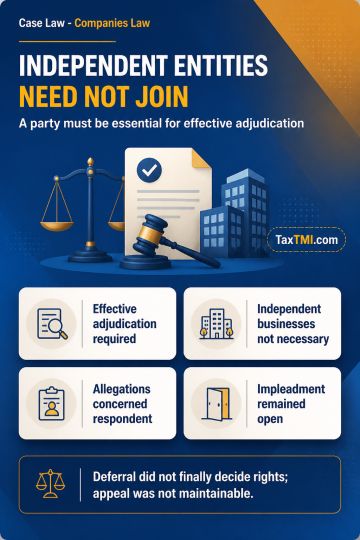
Necessary-party requirements limit impleadment of independent entities, while deferred consideration does not create an appealable adverse determinati...
Food supplement classification requires common parlance and authoritative tests, preventing treatment as proprietary Ayurvedic medicines without suppo...
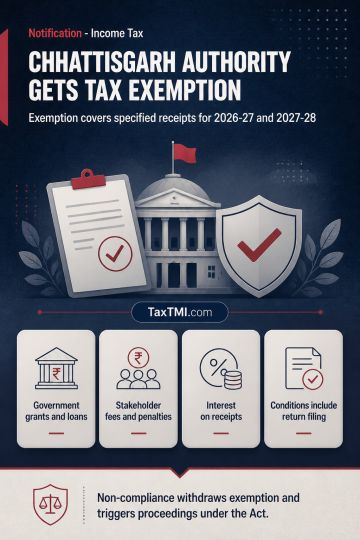
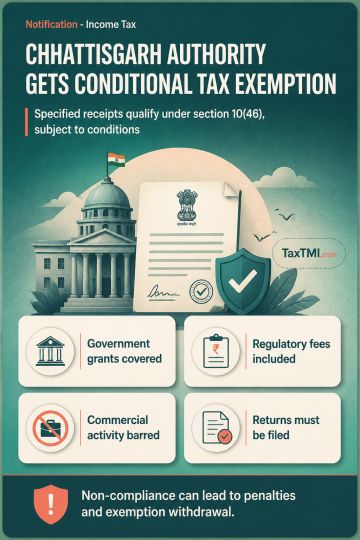
Specified regulatory authority income receives conditional tax exemption, subject to non-commercial activity, unchanged income character, and return f...
Tax exemption for regulatory authority income applies retrospectively, subject to non-commercial activity, unchanged income sources, and return-filing...
Input tax credit conditions remain constitutionally valid, with eligible recipient claims considered under GST circulars and retrospective filing dead...
The assessee challenged the penalty imposed u/s 271(1)(c) for short credit of sale consideration received from the sale of copyrights and cable rights. The issue centered around whether the penalty was levied for concealment of income or furnishing inaccurate particulars of income. The notice issued u/s 274 read with Section 271(1)(c) did not specify the nature of the default. Judicial precedents have held that when the charge is not clearly specified in the penalty notice, the penalty proceedings are rendered invalid. The Hon'ble Supreme Court and Karnataka High Court have ruled that vague notices u/s 274 render the penalty proceedings void ab initio. In the present case, the Assessing Officer failed to specify the exact charge, which is a procedural lapse. Even on merits, the addition sustained by the CIT(Appeals) related to a disputed adjustment of sale consideration, with no finding that the assessee deliberately concealed income or furnished inaccurate particulars. The assessee's explanation appeared bonafide, and there was no evidence of malafide intention. Consequently, the imposition of penalty could not be sustained, and the assessee's appeal was allowed.
The assessee challenged the penalty imposed u/s 271(1)(c) for short credit of sale consideration received from the sale of copyrights and cable rights. The issue centered around whether the penalty was levied for concealment of income or furnishing inaccurate particulars of income. The notice issued u/s 274 read with Section 271(1)(c) did not specify the nature of the default. Judicial precedents have held that when the charge is not clearly specified in the penalty notice, the penalty proceedings are rendered invalid. The Hon'ble Supreme Court and Karnataka High Court have ruled that vague notices u/s 274 render the penalty proceedings void ab initio. In the present case, the Assessing Officer failed to specify the exact charge, which is a procedural lapse. Even on merits, the addition sustained by the CIT(Appeals) related to a disputed adjustment of sale consideration, with no finding that the assessee deliberately concealed income or furnished inaccurate particulars. The assessee's explanation appeared bonafide, and there was no evidence of malafide intention. Consequently, the imposition of penalty could not be sustained, and the assessee's appeal was allowed.
Note: It is a system-generated summary and is for quick reference only.
 TaxTMI
 of 4805
















 Join Channel


 TaxTMI