Online bond platforms may offer overseas-regulated products and tax-specific bonds subject to disclosures, compliance safeguards and revised complianc...
Corporate guarantee valuation permits actual ascertainable commission while barring retroactive application and extended-period penalties for bona fid...
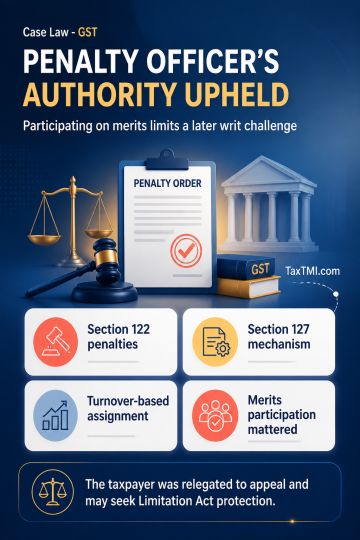
Proper-officer jurisdiction under UPGST penalty provisions upheld; participation on merits prevents bypassing the statutory appellate remedy through w...
Transitioned CENVAT credit may validly satisfy mandatory pre-deposit requirements for legacy service tax appeals through Electronic Credit Ledger debi...
Building-plan sanction charges require statutory authority; unauthorised fees and GST were quashed, while labour cess must follow prescribed collectio...
Pure-agent exclusion fails where hotel booking facilitators receive third-party services themselves, making entire customer consideration taxable as r...
Interpretation of the phrase "reason to believe" u/s 110 of the Customs Act, which is a crucial safeguard for authorizing officers to conduct searches. The court examined the legal principles governing "reason to believe," emphasizing that it cannot be arbitrary, capricious, or whimsical, and must be based on material evidence. The officer must independently apply their mind and not merely reproduce statutory words mechanically. The reasons must be self-explanatory and cannot be supported by extraneous material. In the present case, the suspected opinion of local traders that the seized dried areca nuts were of foreign origin was deemed unreliable and unacceptable, as their origin could not be conclusively determined by mere visual inspection. The court held that the seizure memo lacked valid reasons and set it aside, discharging the bank guarantee and ordering the release of the seized goods within three months.
Interpretation of the phrase "reason to believe" u/s 110 of the Customs Act, which is a crucial safeguard for authorizing officers to conduct searches. The court examined the legal principles governing "reason to believe," emphasizing that it cannot be arbitrary, capricious, or whimsical, and must be based on material evidence. The officer must independently apply their mind and not merely reproduce statutory words mechanically. The reasons must be self-explanatory and cannot be supported by extraneous material. In the present case, the suspected opinion of local traders that the seized dried areca nuts were of foreign origin was deemed unreliable and unacceptable, as their origin could not be conclusively determined by mere visual inspection. The court held that the seizure memo lacked valid reasons and set it aside, discharging the bank guarantee and ordering the release of the seized goods within three months.
Note: It is a system-generated summary and is for quick reference only.
 TaxTMI
 of 4800













 Join Channel


 TaxTMI