Defined public benefit can retain charitable character; registration renewal requires examining genuine activities and legal compliance, not surplus a...
Capital reduction is distinct from share buy-back, preventing buy-back tax; restructuring interest and related business deductions also survive scruti...
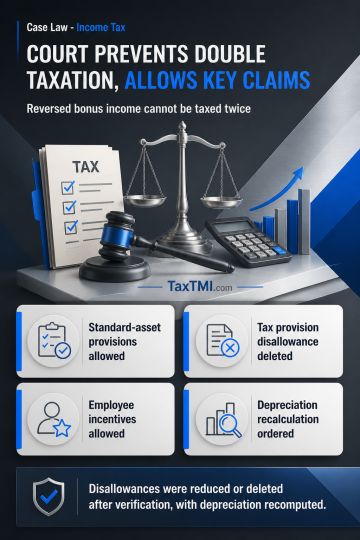
Transfer pricing and tax deductions upheld on established principles, while employee contributions and warranty provisions returned for fresh examinat...
Captive transfer pricing relies on industrial consumer tariffs, while genuine quotations can benchmark effluent treatment transfers under the Other Me...
Specific tariff classification for ophthalmic instruments and extended limitation principles determine the treatment of duty demands, confiscation, an...
Integrated golf function determines classification, placing launch monitors and simulators under other golf equipment rather than measuring instrument...
Interpretation of the phrase "reason to believe" u/s 110 of the Customs Act, which is a crucial safeguard for authorizing officers to conduct searches. The court examined the legal principles governing "reason to believe," emphasizing that it cannot be arbitrary, capricious, or whimsical, and must be based on material evidence. The officer must independently apply their mind and not merely reproduce statutory words mechanically. The reasons must be self-explanatory and cannot be supported by extraneous material. In the present case, the suspected opinion of local traders that the seized dried areca nuts were of foreign origin was deemed unreliable and unacceptable, as their origin could not be conclusively determined by mere visual inspection. The court held that the seizure memo lacked valid reasons and set it aside, discharging the bank guarantee and ordering the release of the seized goods within three months.
Interpretation of the phrase "reason to believe" u/s 110 of the Customs Act, which is a crucial safeguard for authorizing officers to conduct searches. The court examined the legal principles governing "reason to believe," emphasizing that it cannot be arbitrary, capricious, or whimsical, and must be based on material evidence. The officer must independently apply their mind and not merely reproduce statutory words mechanically. The reasons must be self-explanatory and cannot be supported by extraneous material. In the present case, the suspected opinion of local traders that the seized dried areca nuts were of foreign origin was deemed unreliable and unacceptable, as their origin could not be conclusively determined by mere visual inspection. The court held that the seizure memo lacked valid reasons and set it aside, discharging the bank guarantee and ordering the release of the seized goods within three months.
Note: It is a system-generated summary and is for quick reference only.
 TaxTMI
 of 4807


















 Join Channel


 TaxTMI
