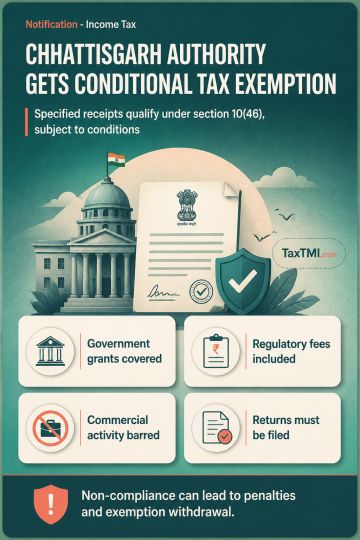
Specified regulatory authority income receives conditional tax exemption, subject to non-commercial activity, unchanged income character, and return f...
Tax exemption for regulatory authority income applies retrospectively, subject to non-commercial activity, unchanged income sources, and return-filing...
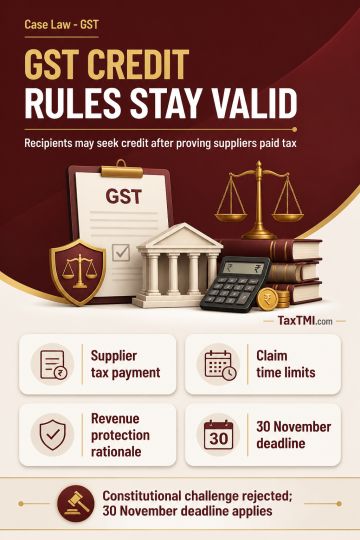
Input tax credit conditions remain constitutionally valid, with eligible recipient claims considered under GST circulars and retrospective filing dead...
Bogus donation receipts justified commission income assessment and defeated political-party tax exemption for inaccurate accounts and reporting failur...
Pure reimbursement without income element escapes tax withholding, while delayed withholding and unsupported provisions face deferred or renewed scrut...
Public benefit requirement defeats charitable registration where residents' association services are reciprocal, member-only facilities governed by mu...
The petition alleges oppression and mismanagement by the company's majority shareholders against the petitioners, who were removed as directors through an Extraordinary General Meeting (EGM). The key points are: The burden is on the petitioners to prove oppressive conduct u/s 242. The EGM notice for removal complied with legal requirements, and the meeting was validly held. The majority shareholders' decision to remove directors cannot be judicially scrutinized as it is part of corporate democracy. Mere inconvenience caused by the legal process doesn't negate its validity. Oppression requires continuous wrongful acts by the majority against the minority, not just lack of confidence. The petitioners failed to prove mismanagement or likelihood of future prejudicial conduct due to the change in management. Consequently, the petition was dismissed for lack of evidence of oppression or mismanagement.
The petition alleges oppression and mismanagement by the company's majority shareholders against the petitioners, who were removed as directors through an Extraordinary General Meeting (EGM). The key points are: The burden is on the petitioners to prove oppressive conduct u/s 242. The EGM notice for removal complied with legal requirements, and the meeting was validly held. The majority shareholders' decision to remove directors cannot be judicially scrutinized as it is part of corporate democracy. Mere inconvenience caused by the legal process doesn't negate its validity. Oppression requires continuous wrongful acts by the majority against the minority, not just lack of confidence. The petitioners failed to prove mismanagement or likelihood of future prejudicial conduct due to the change in management. Consequently, the petition was dismissed for lack of evidence of oppression or mismanagement.
Note: It is a system-generated summary and is for quick reference only.
 TaxTMI
 of 4805

















 Join Channel


 TaxTMI

