Opportunity to respond to jurisdictional reports is mandatory before customs settlement duty enhancement; connected applications require consistent ad...
Specific customs headings for scaffolding components prevail over general classification, invalidating misclassification proceedings and enabling with...
Liquidator appointment under Section 34 requires consideration of creditor recommendations, valid professional authorisation, and preservation of vali...
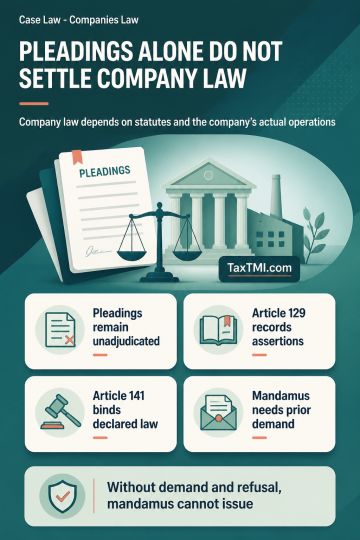
The petition alleges oppression and mismanagement by the company's majority shareholders against the petitioners, who were removed as directors through an Extraordinary General Meeting (EGM). The key points are: The burden is on the petitioners to prove oppressive conduct u/s 242. The EGM notice for removal complied with legal requirements, and the meeting was validly held. The majority shareholders' decision to remove directors cannot be judicially scrutinized as it is part of corporate democracy. Mere inconvenience caused by the legal process doesn't negate its validity. Oppression requires continuous wrongful acts by the majority against the minority, not just lack of confidence. The petitioners failed to prove mismanagement or likelihood of future prejudicial conduct due to the change in management. Consequently, the petition was dismissed for lack of evidence of oppression or mismanagement.
The petition alleges oppression and mismanagement by the company's majority shareholders against the petitioners, who were removed as directors through an Extraordinary General Meeting (EGM). The key points are: The burden is on the petitioners to prove oppressive conduct u/s 242. The EGM notice for removal complied with legal requirements, and the meeting was validly held. The majority shareholders' decision to remove directors cannot be judicially scrutinized as it is part of corporate democracy. Mere inconvenience caused by the legal process doesn't negate its validity. Oppression requires continuous wrongful acts by the majority against the minority, not just lack of confidence. The petitioners failed to prove mismanagement or likelihood of future prejudicial conduct due to the change in management. Consequently, the petition was dismissed for lack of evidence of oppression or mismanagement.
Note: It is a system-generated summary and is for quick reference only.
 TaxTMI
 of 4805


















 Join Channel


 TaxTMI
