Development agreements require legal possession or effective enjoyment for capital gains transfer; permissive possession and deferred consideration de...
Prolonged sterilisation of development rights supports capital-gains treatment, while business-income disallowances cannot govern capital-gains comput...
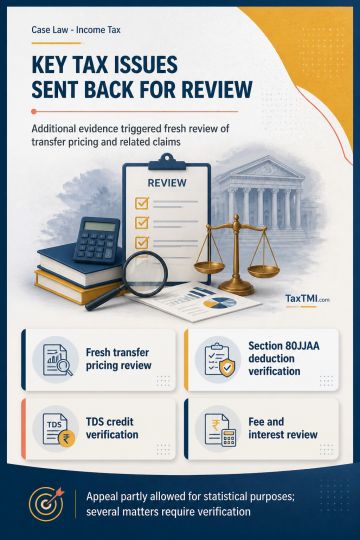
Additional evidence in transfer pricing dispute leads to fresh examination, while tax deductions, TDS credit, fee and refund interest require verifica...
Category II AIF pass-through taxation preserves non-business income character; investment receipts cannot be reclassified without applying recognised ...
Mutual fund maturity rules require proper rollover, redemption, disclosure, and due diligence; investor gains cannot excuse regulatory breaches or pen...
The summary focuses on the irregular availment of the Composition scheme and various demands raised by the adjudicating authority, along with the CESTAT's findings. It covers short payment of tax due to discharge at an incorrect rate, improper application of accrual/realization basis, discrepancies in GL codes and returns, non-maintenance of separate records for dutiable and exempt services, and irregular reversal of Cenvat credit for bad debts written off. The CESTAT examined each issue, relying on relevant legal provisions and judicial precedents. It set aside several demands, upheld a minor demand, and held that extended period invocation and penalties were not warranted due to lack of suppression of facts with intent to evade tax. The appellant's compliance with record-keeping requirements and regular filing of returns were also considered.
The summary focuses on the irregular availment of the Composition scheme and various demands raised by the adjudicating authority, along with the CESTAT's findings. It covers short payment of tax due to discharge at an incorrect rate, improper application of accrual/realization basis, discrepancies in GL codes and returns, non-maintenance of separate records for dutiable and exempt services, and irregular reversal of Cenvat credit for bad debts written off. The CESTAT examined each issue, relying on relevant legal provisions and judicial precedents. It set aside several demands, upheld a minor demand, and held that extended period invocation and penalties were not warranted due to lack of suppression of facts with intent to evade tax. The appellant's compliance with record-keeping requirements and regular filing of returns were also considered.
Note: It is a system-generated summary and is for quick reference only.
 TaxTMI
 of 4807














 Join Channel


 TaxTMI