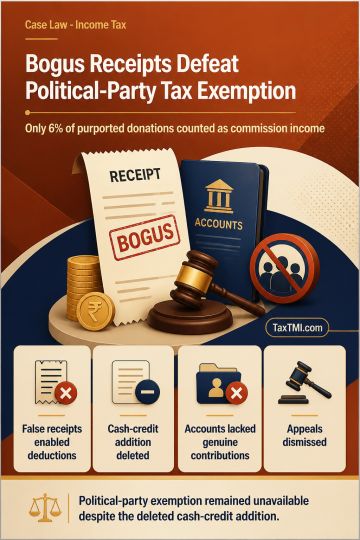
Bogus donation receipts justified commission income assessment and defeated political-party tax exemption for inaccurate accounts and reporting failur...
Pure reimbursement without income element escapes tax withholding, while delayed withholding and unsupported provisions face deferred or renewed scrut...
Public benefit requirement defeats charitable registration where residents' association services are reciprocal, member-only facilities governed by mu...
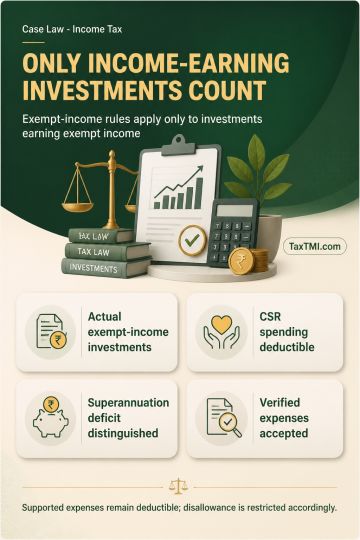
Exempt-income expenditure disallowance is confined to investments that actually generated exempt income, while supported business expenses remain dedu...
Objective characteristics and principal use govern mining-tyre classification, while fresh advance ruling applications may rely on additional technica...
Page of 4805
Press 'Enter' after typing page number.
801 to 820 of 96092 Results
❮
❯
❯❯
0 / 200
Expand Note
Add to Folder
No Folders have been created
+
Are you sure you want to delete "My most important" ?
The Appellate Court exceeded its jurisdiction u/s 37 of the Arbitration and Conciliation Act, 1996, by setting aside an arbitral award that had already been confirmed u/s 34. The Supreme Court reiterated that courts should not interfere with arbitral awards lightly, and mere possibility of an alternative interpretation does not warrant reversal. The scope of intervention is confined to grounds specified u/s 34, and the appellate power u/s 37 is limited to examining if the court u/s 34 acted within its limits. The Appellate Court cannot reappraise evidence on merits as an ordinary court of appeal. Since the arbitral award was reasonable, based on evidence, and not against public policy or law, it was rightly upheld u/s 34. The Appellate Court erred by setting it aside without finding any illegality u/s 34. Merely having a better view is no ground for interference. The Supreme Court set aside the Appellate Court's judgment and restored the arbitral award.
The Appellate Court exceeded its jurisdiction u/s 37 of the Arbitration and Conciliation Act, 1996, by setting aside an arbitral award that had already been confirmed u/s 34. The Supreme Court reiterated that courts should not interfere with arbitral awards lightly, and mere possibility of an alternative interpretation does not warrant reversal. The scope of intervention is confined to grounds specified u/s 34, and the appellate power u/s 37 is limited to examining if the court u/s 34 acted within its limits. The Appellate Court cannot reappraise evidence on merits as an ordinary court of appeal. Since the arbitral award was reasonable, based on evidence, and not against public policy or law, it was rightly upheld u/s 34. The Appellate Court erred by setting it aside without finding any illegality u/s 34. Merely having a better view is no ground for interference. The Supreme Court set aside the Appellate Court's judgment and restored the arbitral award.
Note: It is a system-generated summary and is for quick reference only.
 TaxTMI
 of 4805
















 Join Channel


 TaxTMI