Business expenditure deduction requires proof of genuine commission payments and commercial allowability; turnover growth alone cannot validate the cl...
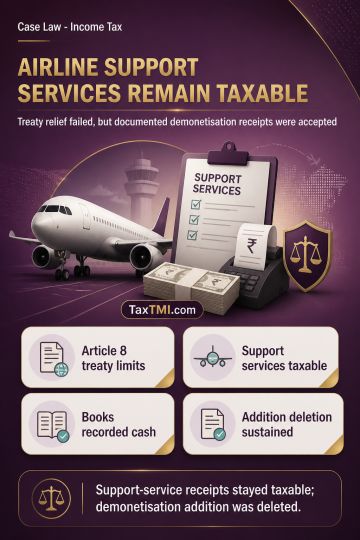
Article 8 treaty coverage excluded third-party airline support services, while documented demonetisation cash receipts remained accepted business inco...
Functional comparability under TNMM requires highway contract benchmarks to reflect operation, maintenance and transfer activities, requiring fresh be...
The Appellate Court exceeded its jurisdiction u/s 37 of the Arbitration and Conciliation Act, 1996, by setting aside an arbitral award that had already been confirmed u/s 34. The Supreme Court reiterated that courts should not interfere with arbitral awards lightly, and mere possibility of an alternative interpretation does not warrant reversal. The scope of intervention is confined to grounds specified u/s 34, and the appellate power u/s 37 is limited to examining if the court u/s 34 acted within its limits. The Appellate Court cannot reappraise evidence on merits as an ordinary court of appeal. Since the arbitral award was reasonable, based on evidence, and not against public policy or law, it was rightly upheld u/s 34. The Appellate Court erred by setting it aside without finding any illegality u/s 34. Merely having a better view is no ground for interference. The Supreme Court set aside the Appellate Court's judgment and restored the arbitral award.
The Appellate Court exceeded its jurisdiction u/s 37 of the Arbitration and Conciliation Act, 1996, by setting aside an arbitral award that had already been confirmed u/s 34. The Supreme Court reiterated that courts should not interfere with arbitral awards lightly, and mere possibility of an alternative interpretation does not warrant reversal. The scope of intervention is confined to grounds specified u/s 34, and the appellate power u/s 37 is limited to examining if the court u/s 34 acted within its limits. The Appellate Court cannot reappraise evidence on merits as an ordinary court of appeal. Since the arbitral award was reasonable, based on evidence, and not against public policy or law, it was rightly upheld u/s 34. The Appellate Court erred by setting it aside without finding any illegality u/s 34. Merely having a better view is no ground for interference. The Supreme Court set aside the Appellate Court's judgment and restored the arbitral award.
Note: It is a system-generated summary and is for quick reference only.
 TaxTMI
 of 4803













 Join Channel


 TaxTMI