Defined public benefit can retain charitable character; registration renewal requires examining genuine activities and legal compliance, not surplus a...
Capital reduction is distinct from share buy-back, preventing buy-back tax; restructuring interest and related business deductions also survive scruti...
Transfer pricing and tax deductions upheld on established principles, while employee contributions and warranty provisions returned for fresh examinat...
Captive transfer pricing relies on industrial consumer tariffs, while genuine quotations can benchmark effluent treatment transfers under the Other Me...
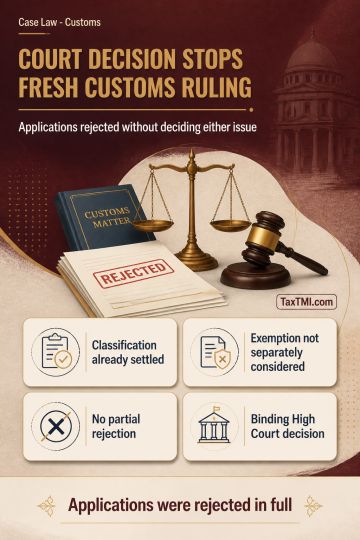
Specific tariff classification for ophthalmic instruments and extended limitation principles determine the treatment of duty demands, confiscation, an...
Integrated golf function determines classification, placing launch monitors and simulators under other golf equipment rather than measuring instrument...
The High Court quashed the reassessment proceedings initiated by the Assessing Officer u/s 148 of the Income Tax Act, holding it to be a case of "change of opinion" and not a valid reassessment. The assessee had acquired equity shares of a closely held company at below fair market value under the 'Right Issue'. Initially, the Principal Commissioner of Income Tax (PCIT) had dropped the proceedings u/s 263 after considering the assessee's submissions. However, the Assessing Officer subsequently issued a notice u/s 148A(b) to reopen the assessment on the same issue. The Court held that reassessment can only be initiated on grounds not previously considered during the original assessment proceedings. Since the PCIT had already examined the issue and decided in favor of the assessee, the Assessing Officer could not reopen the assessment merely on a "change of opinion" based on the same facts. The approval granted by the higher authority (PCCIT) did not confer legitimacy to the reassessment action, as it violated the settled principles governing valid reassessment. Consequently, the reassessment notice, order, and consequential proceedings were quashed.
The High Court quashed the reassessment proceedings initiated by the Assessing Officer u/s 148 of the Income Tax Act, holding it to be a case of "change of opinion" and not a valid reassessment. The assessee had acquired equity shares of a closely held company at below fair market value under the 'Right Issue'. Initially, the Principal Commissioner of Income Tax (PCIT) had dropped the proceedings u/s 263 after considering the assessee's submissions. However, the Assessing Officer subsequently issued a notice u/s 148A(b) to reopen the assessment on the same issue. The Court held that reassessment can only be initiated on grounds not previously considered during the original assessment proceedings. Since the PCIT had already examined the issue and decided in favor of the assessee, the Assessing Officer could not reopen the assessment merely on a "change of opinion" based on the same facts. The approval granted by the higher authority (PCCIT) did not confer legitimacy to the reassessment action, as it violated the settled principles governing valid reassessment. Consequently, the reassessment notice, order, and consequential proceedings were quashed.
Note: It is a system-generated summary and is for quick reference only.
 TaxTMI
 of 4794




















 Join Channel


 TaxTMI
