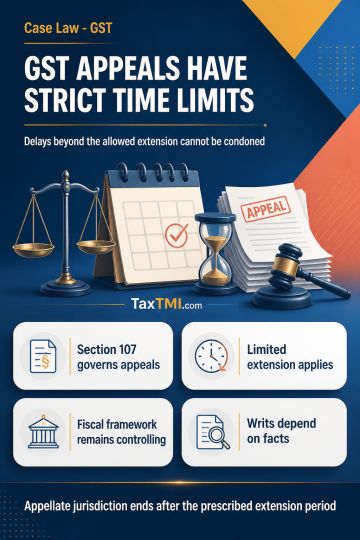
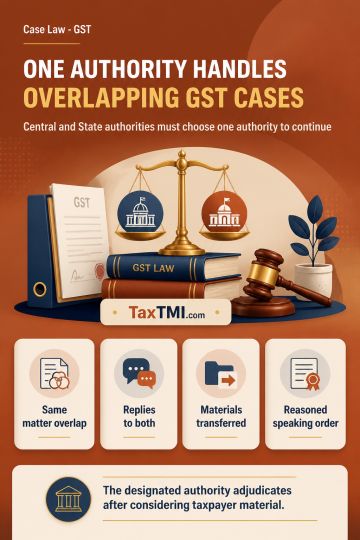
Overlapping GST proceedings require Central and State authorities to designate one competent authority for coordinated adjudication of the same matter...
Composite healthcare supplies retain exemption when patient care is the contract's essential character, despite payment through an implementing agency...
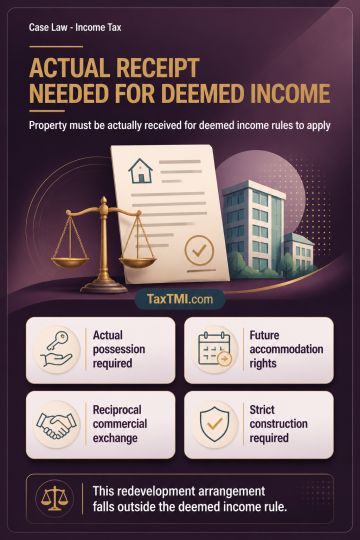
Receipt of immovable property requires actual possession or enjoyment; redevelopment allotments exchanged for tenancy rights fall outside deemed incom...
The High Court quashed the reassessment proceedings initiated by the Assessing Officer u/s 148 of the Income Tax Act, holding it to be a case of "change of opinion" and not a valid reassessment. The assessee had acquired equity shares of a closely held company at below fair market value under the 'Right Issue'. Initially, the Principal Commissioner of Income Tax (PCIT) had dropped the proceedings u/s 263 after considering the assessee's submissions. However, the Assessing Officer subsequently issued a notice u/s 148A(b) to reopen the assessment on the same issue. The Court held that reassessment can only be initiated on grounds not previously considered during the original assessment proceedings. Since the PCIT had already examined the issue and decided in favor of the assessee, the Assessing Officer could not reopen the assessment merely on a "change of opinion" based on the same facts. The approval granted by the higher authority (PCCIT) did not confer legitimacy to the reassessment action, as it violated the settled principles governing valid reassessment. Consequently, the reassessment notice, order, and consequential proceedings were quashed.
The High Court quashed the reassessment proceedings initiated by the Assessing Officer u/s 148 of the Income Tax Act, holding it to be a case of "change of opinion" and not a valid reassessment. The assessee had acquired equity shares of a closely held company at below fair market value under the 'Right Issue'. Initially, the Principal Commissioner of Income Tax (PCIT) had dropped the proceedings u/s 263 after considering the assessee's submissions. However, the Assessing Officer subsequently issued a notice u/s 148A(b) to reopen the assessment on the same issue. The Court held that reassessment can only be initiated on grounds not previously considered during the original assessment proceedings. Since the PCIT had already examined the issue and decided in favor of the assessee, the Assessing Officer could not reopen the assessment merely on a "change of opinion" based on the same facts. The approval granted by the higher authority (PCCIT) did not confer legitimacy to the reassessment action, as it violated the settled principles governing valid reassessment. Consequently, the reassessment notice, order, and consequential proceedings were quashed.
Note: It is a system-generated summary and is for quick reference only.
 TaxTMI
 of 4792












 Join Channel


 TaxTMI
