Prolonged sterilisation of development rights supports capital-gains treatment, while business-income disallowances cannot govern capital-gains comput...
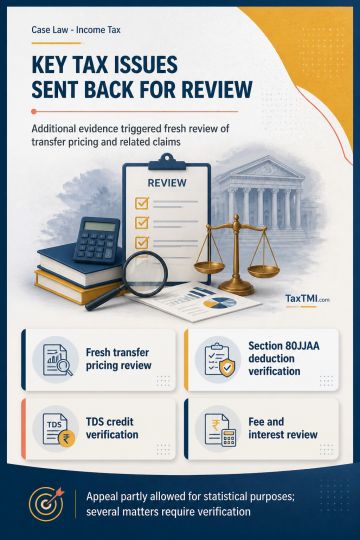
Additional evidence in transfer pricing dispute leads to fresh examination, while tax deductions, TDS credit, fee and refund interest require verifica...
Category II AIF pass-through taxation preserves non-business income character; investment receipts cannot be reclassified without applying recognised ...
Mutual fund maturity rules require proper rollover, redemption, disclosure, and due diligence; investor gains cannot excuse regulatory breaches or pen...
Threshold exemption excludes exempt services, while stamp-paper purchases avoid reverse charge; consequential service tax penalties were also set asid...
The High Court held that the petitioner should avail the statutory remedy of appeal against the order u/s 201(1) raising a demand and interest u/s 201(1A) for non-deduction of TDS u/s 195 on acquisition/purchase of a Trade Mark registered in India from foreign/non-resident group entities. The Court opined that mixed issues of fact and law arise, including applicability of territoriality principles and situs of the Trade Mark, which can be effectively examined by the Appellate Authority. The Court observed that the Assessing Officer did not confer jurisdiction upon himself contrary to the Income Tax Act provisions. The applicability or non-applicability of a judicial decision does not present a core jurisdictional issue when tested against the powers conferred under the Act. The Court emphasized that entertaining the writ petition would render the appellate remedy a mere paper provision. The Court also noted the absence of a one-year limitation for an order u/s 201(1) concerning non-residents. Consequently, the Court dismissed the writ petition, permitting the petitioner to file an appeal within 15 days and seek appropriate orders regarding the penalty proceedings and stay on demand enforcement.
The High Court held that the petitioner should avail the statutory remedy of appeal against the order u/s 201(1) raising a demand and interest u/s 201(1A) for non-deduction of TDS u/s 195 on acquisition/purchase of a Trade Mark registered in India from foreign/non-resident group entities. The Court opined that mixed issues of fact and law arise, including applicability of territoriality principles and situs of the Trade Mark, which can be effectively examined by the Appellate Authority. The Court observed that the Assessing Officer did not confer jurisdiction upon himself contrary to the Income Tax Act provisions. The applicability or non-applicability of a judicial decision does not present a core jurisdictional issue when tested against the powers conferred under the Act. The Court emphasized that entertaining the writ petition would render the appellate remedy a mere paper provision. The Court also noted the absence of a one-year limitation for an order u/s 201(1) concerning non-residents. Consequently, the Court dismissed the writ petition, permitting the petitioner to file an appeal within 15 days and seek appropriate orders regarding the penalty proceedings and stay on demand enforcement.
Note: It is a system-generated summary and is for quick reference only.
 TaxTMI
 of 4792





















 Join Channel


 TaxTMI
