Statutory transfer formalities invalidated alleged share and property transfers, while retrospective record manipulation constituted oppression and mi...
Provisional attachment of laundered funds and equivalent-value property sustained, with statutory protection limited to pension, gratuity and providen...
Insolvency moratorium does not shield company officers from cheque dishonour prosecution for liability arising before corporate insolvency proceedings...
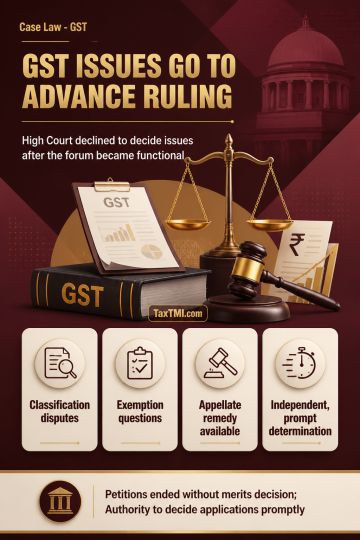
Advance-ruling mechanism governs pending GST classification, exemption and taxability disputes, limiting writ review once the specialised forum functi...
Page of 4788
Press 'Enter' after typing page number.
581 to 600 of 95752 Results
❮
❯
❯❯
0 / 200
Expand Note
Add to Folder
No Folders have been created
+
Are you sure you want to delete "My most important" ?
The High Court held that the petitioner should avail the statutory remedy of appeal against the order u/s 201(1) raising a demand and interest u/s 201(1A) for non-deduction of TDS u/s 195 on acquisition/purchase of a Trade Mark registered in India from foreign/non-resident group entities. The Court opined that mixed issues of fact and law arise, including applicability of territoriality principles and situs of the Trade Mark, which can be effectively examined by the Appellate Authority. The Court observed that the Assessing Officer did not confer jurisdiction upon himself contrary to the Income Tax Act provisions. The applicability or non-applicability of a judicial decision does not present a core jurisdictional issue when tested against the powers conferred under the Act. The Court emphasized that entertaining the writ petition would render the appellate remedy a mere paper provision. The Court also noted the absence of a one-year limitation for an order u/s 201(1) concerning non-residents. Consequently, the Court dismissed the writ petition, permitting the petitioner to file an appeal within 15 days and seek appropriate orders regarding the penalty proceedings and stay on demand enforcement.
The High Court held that the petitioner should avail the statutory remedy of appeal against the order u/s 201(1) raising a demand and interest u/s 201(1A) for non-deduction of TDS u/s 195 on acquisition/purchase of a Trade Mark registered in India from foreign/non-resident group entities. The Court opined that mixed issues of fact and law arise, including applicability of territoriality principles and situs of the Trade Mark, which can be effectively examined by the Appellate Authority. The Court observed that the Assessing Officer did not confer jurisdiction upon himself contrary to the Income Tax Act provisions. The applicability or non-applicability of a judicial decision does not present a core jurisdictional issue when tested against the powers conferred under the Act. The Court emphasized that entertaining the writ petition would render the appellate remedy a mere paper provision. The Court also noted the absence of a one-year limitation for an order u/s 201(1) concerning non-residents. Consequently, the Court dismissed the writ petition, permitting the petitioner to file an appeal within 15 days and seek appropriate orders regarding the penalty proceedings and stay on demand enforcement.
Note: It is a system-generated summary and is for quick reference only.
 TaxTMI
 of 4788




















 Join Channel


 TaxTMI