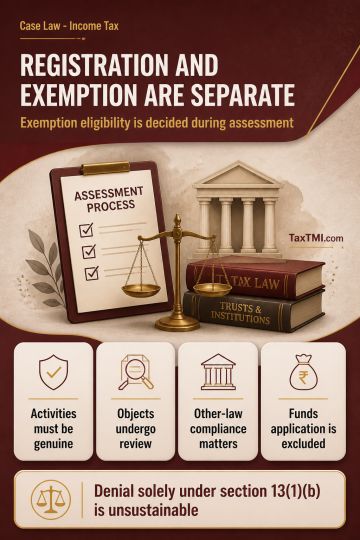
Defined public benefit can retain charitable character; registration renewal requires examining genuine activities and legal compliance, not surplus a...
Capital reduction is distinct from share buy-back, preventing buy-back tax; restructuring interest and related business deductions also survive scruti...
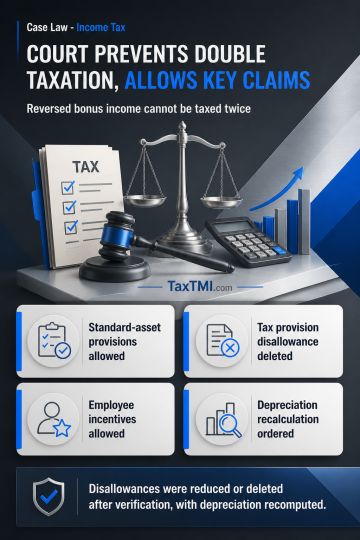
Transfer pricing and tax deductions upheld on established principles, while employee contributions and warranty provisions returned for fresh examinat...
Captive transfer pricing relies on industrial consumer tariffs, while genuine quotations can benchmark effluent treatment transfers under the Other Me...
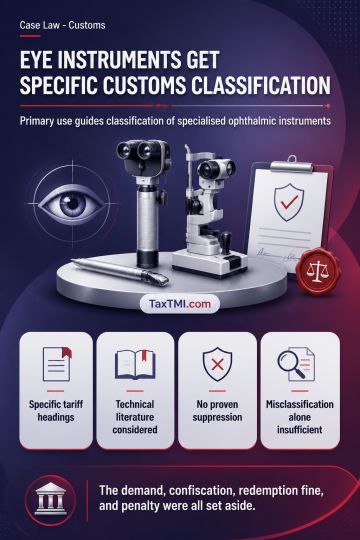
Specific tariff classification for ophthalmic instruments and extended limitation principles determine the treatment of duty demands, confiscation, an...
Page of 4801
Press 'Enter' after typing page number.
1161 to 1180 of 96001 Results
❮
❯
❯❯
0 / 200
Expand Note
Add to Folder
No Folders have been created
+
Are you sure you want to delete "My most important" ?
The High Court held that the Income Tax authorities have the power to seek interim custody of currency notes seized and produced before the jurisdictional magistrate or reported to the magistrate u/s 102 of the Criminal Procedure Code. When the Income Tax Act empowers the competent authority to requisition assets of assessees and adjust them towards liabilities, if there is reason to believe that the asset represents undisclosed income or property, the competent authority is best suited to hold the seized currency notes until the inquiry or trial concludes. Section 132A allows requisitioning books of account, and the competent authority can seek interim custody of seized assets, even if unable to issue a requisition u/s 132A when the asset is produced before the magistrate. The competent authority can apply for interim custody u/s 451 of the CrPC to prevent Sections 132A and 132B from becoming futile. The direction in an earlier case for returning the amount if proceedings are not completed within six months is unwarranted, as disbursement can be ordered only at the conclusion of the inquiry or trial u/s 452 of the CrPC.
The High Court held that the Income Tax authorities have the power to seek interim custody of currency notes seized and produced before the jurisdictional magistrate or reported to the magistrate u/s 102 of the Criminal Procedure Code. When the Income Tax Act empowers the competent authority to requisition assets of assessees and adjust them towards liabilities, if there is reason to believe that the asset represents undisclosed income or property, the competent authority is best suited to hold the seized currency notes until the inquiry or trial concludes. Section 132A allows requisitioning books of account, and the competent authority can seek interim custody of seized assets, even if unable to issue a requisition u/s 132A when the asset is produced before the magistrate. The competent authority can apply for interim custody u/s 451 of the CrPC to prevent Sections 132A and 132B from becoming futile. The direction in an earlier case for returning the amount if proceedings are not completed within six months is unwarranted, as disbursement can be ordered only at the conclusion of the inquiry or trial u/s 452 of the CrPC.
Note: It is a system-generated summary and is for quick reference only.
 TaxTMI
 of 4801














 Join Channel


 TaxTMI