Development agreements require legal possession or effective enjoyment for capital gains transfer; permissive possession and deferred consideration de...
Prolonged sterilisation of development rights supports capital-gains treatment, while business-income disallowances cannot govern capital-gains comput...
Additional evidence in transfer pricing dispute leads to fresh examination, while tax deductions, TDS credit, fee and refund interest require verifica...
Category II AIF pass-through taxation preserves non-business income character; investment receipts cannot be reclassified without applying recognised ...
Mutual fund maturity rules require proper rollover, redemption, disclosure, and due diligence; investor gains cannot excuse regulatory breaches or pen...
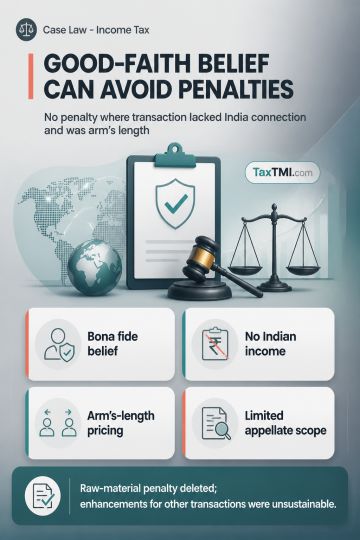
The assessee received an unsecured loan of Rs. 1 crore from M/s Betala Investment Finance Ltd., which was later transferred to Lahoti Holding Ltd. due to a name change. The authorities accepted the explanation regarding the source of the loan. Regarding stock valuation, the assessee followed a consistent method, and the authorities upheld the assessee's valuation. The authorities also accepted the assessee's explanation for the difference in raw material consumption, considering it a clerical mistake. The addition u/s 41(1) for cessation of liability was deleted as the revenue could not establish remission of income. The disallowance of interest paid above 12% on unsecured loans was rejected, following the principle of consistency as the same rates were allowed in earlier years. The addition based on the stock statement submitted to the bank for obtaining credit limits was deleted, relying on judicial precedents that such statements cannot be the basis for additions u/s 69B.
The assessee received an unsecured loan of Rs. 1 crore from M/s Betala Investment Finance Ltd., which was later transferred to Lahoti Holding Ltd. due to a name change. The authorities accepted the explanation regarding the source of the loan. Regarding stock valuation, the assessee followed a consistent method, and the authorities upheld the assessee's valuation. The authorities also accepted the assessee's explanation for the difference in raw material consumption, considering it a clerical mistake. The addition u/s 41(1) for cessation of liability was deleted as the revenue could not establish remission of income. The disallowance of interest paid above 12% on unsecured loans was rejected, following the principle of consistency as the same rates were allowed in earlier years. The addition based on the stock statement submitted to the bank for obtaining credit limits was deleted, relying on judicial precedents that such statements cannot be the basis for additions u/s 69B.
Note: It is a system-generated summary and is for quick reference only.
 TaxTMI
 of 4798




















 Join Channel


 TaxTMI
