Development agreements require legal possession or effective enjoyment for capital gains transfer; permissive possession and deferred consideration de...
Prolonged sterilisation of development rights supports capital-gains treatment, while business-income disallowances cannot govern capital-gains comput...
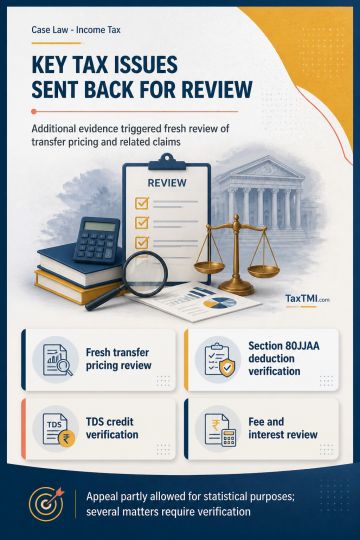
Additional evidence in transfer pricing dispute leads to fresh examination, while tax deductions, TDS credit, fee and refund interest require verifica...
Category II AIF pass-through taxation preserves non-business income character; investment receipts cannot be reclassified without applying recognised ...
The petitioner, accused of money laundering under the Prevention of Money Laundering Act (PMLA), sought bail. The court held that Section 45 of PMLA imposes stringent conditions for granting bail, requiring the court to be satisfied that there are reasonable grounds to believe the accused is not guilty and is unlikely to commit an offence while on bail. The prosecution alleged the petitioner influenced a bank to sanction loans to Kiran P.P., from which the petitioner received Rs. 14 crore. The court found prima facie evidence supporting the allegations, including inconsistent statements, unexplained cash credits, and unaccounted capital in the petitioner's business. Relying on Supreme Court precedents, the court concluded there were no reasonable grounds to believe the petitioner was not guilty and denied bail, considering the serious nature of the accusations.
The petitioner, accused of money laundering under the Prevention of Money Laundering Act (PMLA), sought bail. The court held that Section 45 of PMLA imposes stringent conditions for granting bail, requiring the court to be satisfied that there are reasonable grounds to believe the accused is not guilty and is unlikely to commit an offence while on bail. The prosecution alleged the petitioner influenced a bank to sanction loans to Kiran P.P., from which the petitioner received Rs. 14 crore. The court found prima facie evidence supporting the allegations, including inconsistent statements, unexplained cash credits, and unaccounted capital in the petitioner's business. Relying on Supreme Court precedents, the court concluded there were no reasonable grounds to believe the petitioner was not guilty and denied bail, considering the serious nature of the accusations.
Note: It is a system-generated summary and is for quick reference only.
 TaxTMI
 of 4800
















 Join Channel


 TaxTMI
