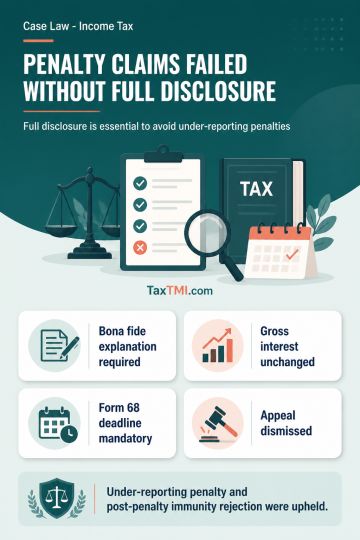
Bona fide disclosure requirements govern under-reporting penalties, and post-penalty immunity applications cannot secure available statutory protectio...
Certificate-of-origin verification procedure governs preferential customs benefits; denial without retroactive verification was set aside with consequ...
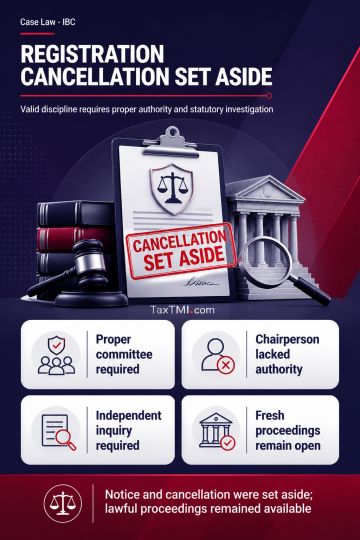
Disciplinary Committee jurisdiction and mandatory investigation requirements invalidated cancellation of an insolvency professional's registration and...
Retention of seized property survives where recorded reasons support proceeds of crime, while stayed investigation periods are excluded from limitatio...
Page of 4800
Press 'Enter' after typing page number.
1121 to 1140 of 95999 Results
❮
❯
❯❯
0 / 200
Expand Note
Add to Folder
No Folders have been created
+
Are you sure you want to delete "My most important" ?
The provisions of section 69A allow for additions if the assessee is found to be the owner of unrecorded money, bullion, jewelry, or valuable articles. However, when sales are duly recorded and supported by the books of account, additions cannot be made u/s 69A. The assessee's books were rejected, and profits were estimated at 10% on the money deposited in the bank account. The Assessing Officer made a trading addition without reducing the profit already reflected in the books. The tribunal directed the Assessing Officer to reduce the profit already declared by the assessee at 5.74% and consider the remaining 4.26% as a trading addition. Regarding section 145(3), once the books of account are rejected based on detailed reasons, rejecting the method of accounting and stock valuation is not necessary. The assessee did not challenge the rejection of books, and the tribunal found no infirmity in the findings of the lower authorities.
The provisions of section 69A allow for additions if the assessee is found to be the owner of unrecorded money, bullion, jewelry, or valuable articles. However, when sales are duly recorded and supported by the books of account, additions cannot be made u/s 69A. The assessee's books were rejected, and profits were estimated at 10% on the money deposited in the bank account. The Assessing Officer made a trading addition without reducing the profit already reflected in the books. The tribunal directed the Assessing Officer to reduce the profit already declared by the assessee at 5.74% and consider the remaining 4.26% as a trading addition. Regarding section 145(3), once the books of account are rejected based on detailed reasons, rejecting the method of accounting and stock valuation is not necessary. The assessee did not challenge the rejection of books, and the tribunal found no infirmity in the findings of the lower authorities.
Note: It is a system-generated summary and is for quick reference only.
 TaxTMI
 of 4800














 Join Channel


 TaxTMI
