Defined public benefit can retain charitable character; registration renewal requires examining genuine activities and legal compliance, not surplus a...
Capital reduction is distinct from share buy-back, preventing buy-back tax; restructuring interest and related business deductions also survive scruti...
Transfer pricing and tax deductions upheld on established principles, while employee contributions and warranty provisions returned for fresh examinat...
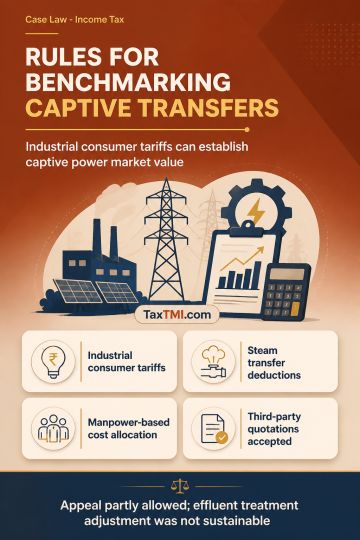
Captive transfer pricing relies on industrial consumer tariffs, while genuine quotations can benchmark effluent treatment transfers under the Other Me...
Specific tariff classification for ophthalmic instruments and extended limitation principles determine the treatment of duty demands, confiscation, an...
Integrated golf function determines classification, placing launch monitors and simulators under other golf equipment rather than measuring instrument...
Page of 4796
Press 'Enter' after typing page number.
1081 to 1100 of 95918 Results
❮
❯
❯❯
0 / 200
Expand Note
Add to Folder
No Folders have been created
+
Are you sure you want to delete "My most important" ?
Profit estimation on unaccounted turnover: AO estimated 8% profit based on seized material, which was reduced to 5% by CIT(A). ITAT held that in case of profit estimation u/s 145, Revenue must make an honest and fair estimate by applying the profit rate declared in preceding years. Considering the assessee's business of trading in Kirana items, ITAT opined that 4% profit amounting to Rs. 35,70,673 shall meet justice. Since Rs. 75 lakh was offered for taxation as business income, the additional profit needs to be telescoped with the offered income, and no separate addition is required. Unexplained expenditure: Assessee argued that once books were rejected and profits estimated on turnover, expenses for earning such profits should be considered, and any addition for expenses would amount to double addition. ITAT held that the expenditure on unrecorded cash coupons is treated as unexplained expenditure u/s 69C and taxed at 60% u/s 115BBE. However, the basic invocation of Section 69C based on estimates is uncalled for. CIT(A) appropriately decided, and ITAT upheld the order. 4% net profit on turnover: ITAT found that CIT(A) correctly considered the additional income of Rs. 75.
Profit estimation on unaccounted turnover: AO estimated 8% profit based on seized material, which was reduced to 5% by CIT(A). ITAT held that in case of profit estimation u/s 145, Revenue must make an honest and fair estimate by applying the profit rate declared in preceding years. Considering the assessee's business of trading in Kirana items, ITAT opined that 4% profit amounting to Rs. 35,70,673 shall meet justice. Since Rs. 75 lakh was offered for taxation as business income, the additional profit needs to be telescoped with the offered income, and no separate addition is required. Unexplained expenditure: Assessee argued that once books were rejected and profits estimated on turnover, expenses for earning such profits should be considered, and any addition for expenses would amount to double addition. ITAT held that the expenditure on unrecorded cash coupons is treated as unexplained expenditure u/s 69C and taxed at 60% u/s 115BBE. However, the basic invocation of Section 69C based on estimates is uncalled for. CIT(A) appropriately decided, and ITAT upheld the order. 4% net profit on turnover: ITAT found that CIT(A) correctly considered the additional income of Rs. 75.
Note: It is a system-generated summary and is for quick reference only.
 TaxTMI
 of 4796












 Join Channel


 TaxTMI