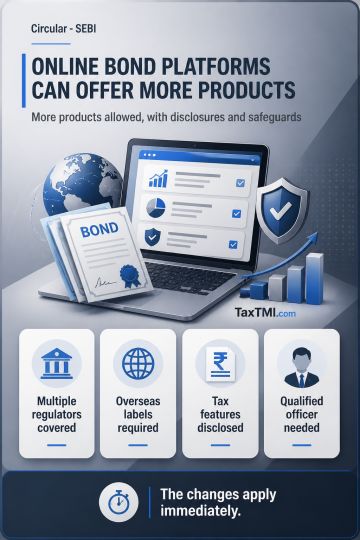
Online bond platforms may offer overseas-regulated products and tax-specific bonds subject to disclosures, compliance safeguards and revised complianc...
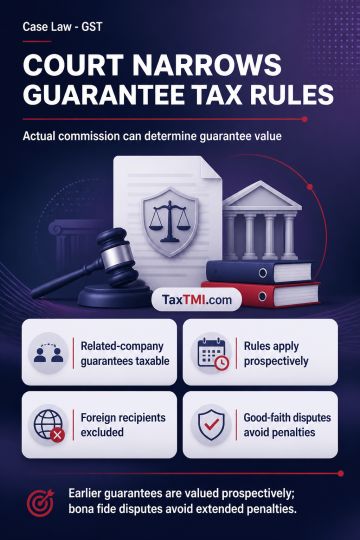
Corporate guarantee valuation permits actual ascertainable commission while barring retroactive application and extended-period penalties for bona fid...
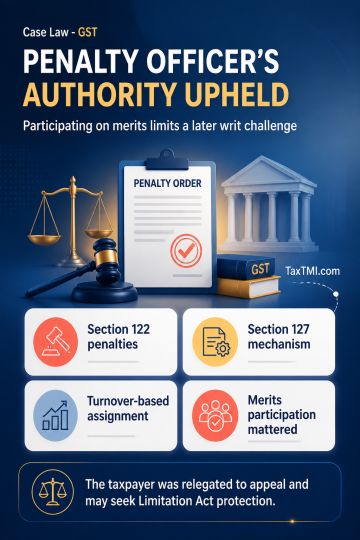
Proper-officer jurisdiction under UPGST penalty provisions upheld; participation on merits prevents bypassing the statutory appellate remedy through w...
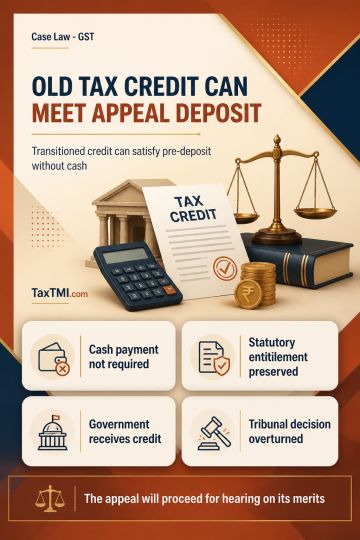
Transitioned CENVAT credit may validly satisfy mandatory pre-deposit requirements for legacy service tax appeals through Electronic Credit Ledger debi...
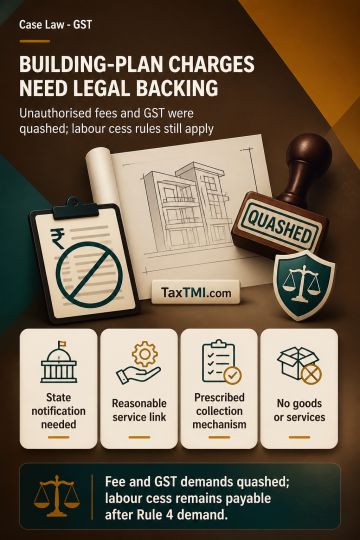
Building-plan sanction charges require statutory authority; unauthorised fees and GST were quashed, while labour cess must follow prescribed collectio...
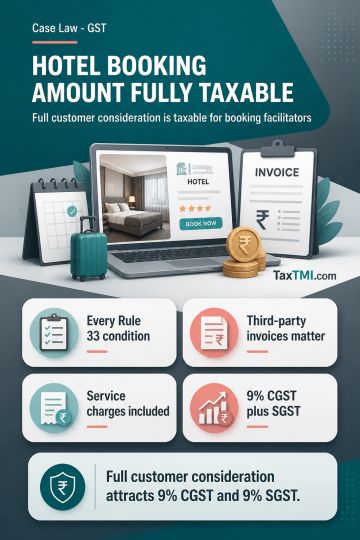
Pure-agent exclusion fails where hotel booking facilitators receive third-party services themselves, making entire customer consideration taxable as r...
The High Court examined the validity of Notification No. 56/2023-CT dated 28.12.2023, which extended the time limit for passing orders u/s 73 of the Central Goods and Services Tax Act (CGST Act). The key issues were the absence of a recommendation from the GST Council and the absence of a corresponding state government notification parallel to the Central Government's notification. The Court held that exercising powers u/s 168A of the CGST Act to extend time limits requires a recommendation from the GST Council and the existence of force majeure circumstances, as defined in the Explanation to Section 168A. Citing the Supreme Court's judgment in V.M. Kurian Vs. State of Kerala, the Court emphasized that the word "recommendation" implies a statement expressing commendation, and its meaning must be understood in the context of the relevant provisions and objects. The Court observed that the CGST Act and State GST Acts do not define "recommendation" but noted the constitutional provisions promoting fiscal and cooperative federalism. Consequently, the Court ruled that the Notification No. 56/2023-CT is ultra vires the CGST Act and legally unsustainable, setting it aside. The Orders-in-Original passed u/s 73(9) of the CGST Act and State GST Act beyond the prescribed time limit u/s 73(10.
The High Court examined the validity of Notification No. 56/2023-CT dated 28.12.2023, which extended the time limit for passing orders u/s 73 of the Central Goods and Services Tax Act (CGST Act). The key issues were the absence of a recommendation from the GST Council and the absence of a corresponding state government notification parallel to the Central Government's notification. The Court held that exercising powers u/s 168A of the CGST Act to extend time limits requires a recommendation from the GST Council and the existence of force majeure circumstances, as defined in the Explanation to Section 168A. Citing the Supreme Court's judgment in V.M. Kurian Vs. State of Kerala, the Court emphasized that the word "recommendation" implies a statement expressing commendation, and its meaning must be understood in the context of the relevant provisions and objects. The Court observed that the CGST Act and State GST Acts do not define "recommendation" but noted the constitutional provisions promoting fiscal and cooperative federalism. Consequently, the Court ruled that the Notification No. 56/2023-CT is ultra vires the CGST Act and legally unsustainable, setting it aside. The Orders-in-Original passed u/s 73(9) of the CGST Act and State GST Act beyond the prescribed time limit u/s 73(10.
Note: It is a system-generated summary and is for quick reference only.
 TaxTMI
 of 4800




 Join Channel


 TaxTMI