TNMM functional comparability requires excluding rice manufacturers from a pure Basmati rice trader's benchmark and recognising operating export recei...
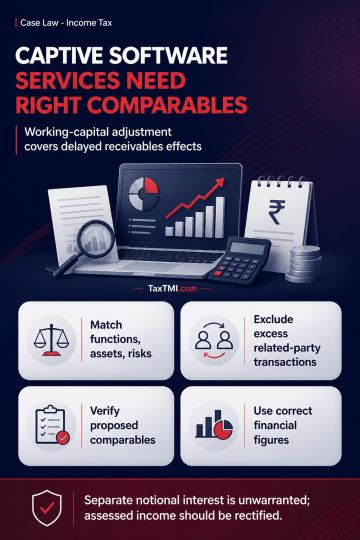
Working-capital adjustment subsumes delayed-receivable effects in TNMM benchmarking of captive software-development services, avoiding separate notion...
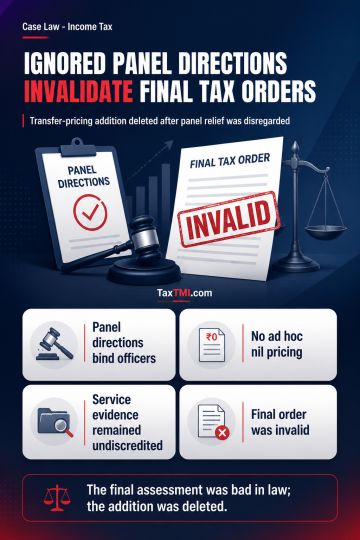
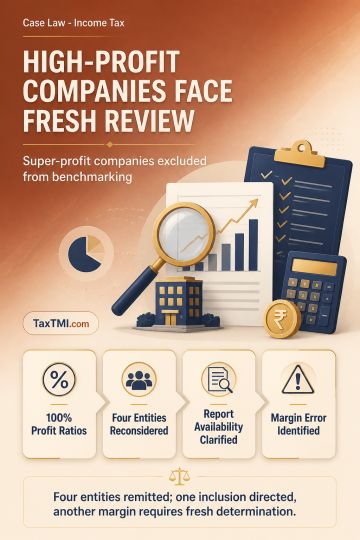
Transfer-pricing comparability requires exclusion of financially illogical super-profit comparables and correction of unsupported annual-report and ma...
Charitable character assessment preserves Section 80G approval despite inclusive spiritual teachings and incidental religious expenditure within the s...
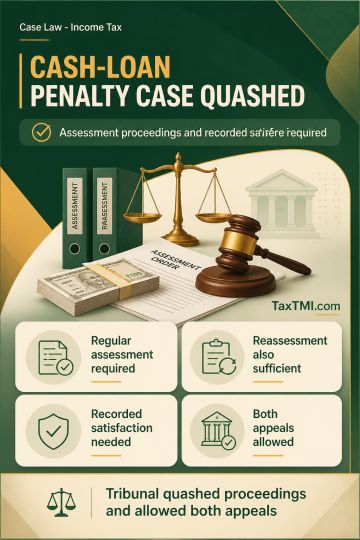
Penalty proceedings for cash-loan acceptance require assessment proceedings and recorded Assessing Officer satisfaction; absent these, the proceedings...
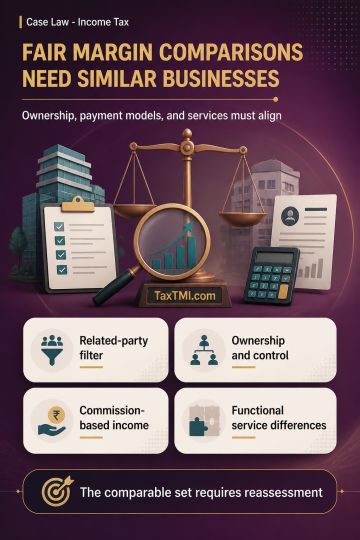
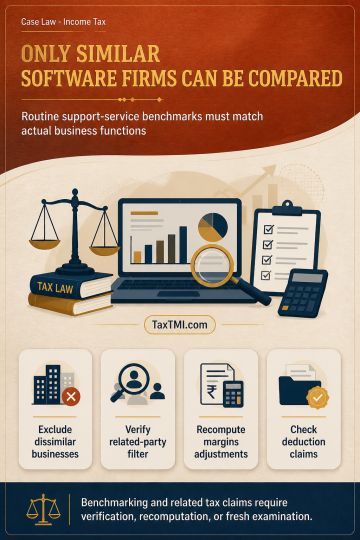
Functional comparability governs software-service benchmarking: dissimilar companies are excluded, while related-party filters, margins and working-ca...
The case pertains to the scope of limited scrutiny by the assessing officer regarding computation of capital gains u/s 45 and providing exemption u/s 54B of the Income Tax Act. The key points are: The assessee's case was selected for limited scrutiny to verify the deduction claimed u/s 54B. However, the assessing officer exceeded jurisdiction by disallowing the fair market value claimed u/s 45 for computing capital gains, which was beyond the limited scrutiny scope. This violated CBDT instructions limiting the scrutiny scope. The assessment order u/s 143(3) became invalid as the officer traveled beyond the assigned jurisdiction of limited scrutiny. To examine aspects beyond limited scrutiny like cost of acquisition u/s 45, the assessing officer should have taken permission from higher authorities, which was not done. The limited scrutiny scope is narrow as per CBDT instructions, restricting inquiry to specified issues. Linking provisions of Section 54B with Section 48 for enhancing capital gains u/s 45 is impermissible without requisite permissions. Revenue authorities cannot travel beyond limited scrutiny issues without completing formalities for extending scrutiny scope. The assessing officer's addition on issues outside limited scrutiny reasons is invalid. The assessee's appeal is allowed as the officer exceeded jurisdiction.
The case pertains to the scope of limited scrutiny by the assessing officer regarding computation of capital gains u/s 45 and providing exemption u/s 54B of the Income Tax Act. The key points are: The assessee's case was selected for limited scrutiny to verify the deduction claimed u/s 54B. However, the assessing officer exceeded jurisdiction by disallowing the fair market value claimed u/s 45 for computing capital gains, which was beyond the limited scrutiny scope. This violated CBDT instructions limiting the scrutiny scope. The assessment order u/s 143(3) became invalid as the officer traveled beyond the assigned jurisdiction of limited scrutiny. To examine aspects beyond limited scrutiny like cost of acquisition u/s 45, the assessing officer should have taken permission from higher authorities, which was not done. The limited scrutiny scope is narrow as per CBDT instructions, restricting inquiry to specified issues. Linking provisions of Section 54B with Section 48 for enhancing capital gains u/s 45 is impermissible without requisite permissions. Revenue authorities cannot travel beyond limited scrutiny issues without completing formalities for extending scrutiny scope. The assessing officer's addition on issues outside limited scrutiny reasons is invalid. The assessee's appeal is allowed as the officer exceeded jurisdiction.
Note: It is a system-generated summary and is for quick reference only.
 TaxTMI
  TaxTMI
 of 4830









 Join Channel


