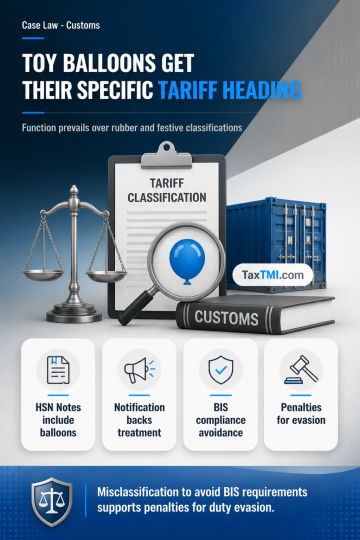
Toy balloon tariff classification: functional heading prevails over residual rubber and festive article headings, supporting penalties for deliberate ...
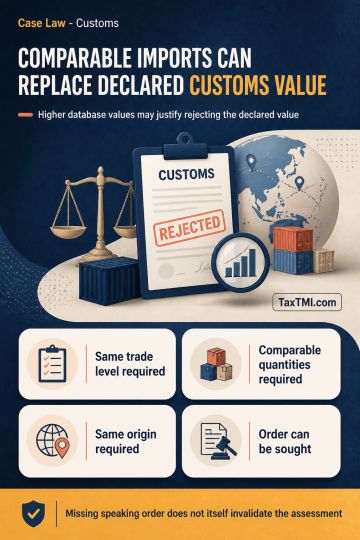
Customs valuation using comparable contemporaneous imports can displace declared value, while missing speaking orders require pursuit before competent...
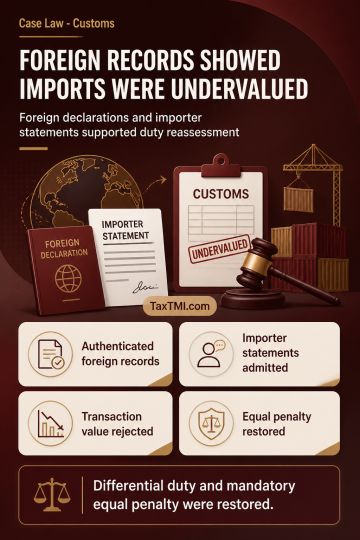
Foreign customs declarations and importer admissions established undervaluation, supporting sequential value redetermination, differential duty, and m...
Customs seizure safeguards prevent detention-based limitation avoidance and invalidate provisional release conditions for imported vehicles under an i...
Page of 4828
Press 'Enter' after typing page number.
361 to 380 of 96556 Results
❮
❯
❯❯
0 / 200
Expand Note
Add to Folder
No Folders have been created
+
Are you sure you want to delete "My most important" ?
The High Court dismissed the revenue's appeal against the Tribunal's order, upholding the Tribunal's view that the Customs Broker Licensing Regulations (CBLR) 2013 do not mandate physical verification of exporters, their premises, or antecedents. The allegation was that the respondent customs broker initiated clearance without meeting the exporter's authorized person and received work through intermediaries. However, the Tribunal found this permissible under the CBLR. The Court noted that the Department did not investigate how the seal was affixed or officials' involvement. Additionally, parallel proceedings against the respondent's partner concluded favorably, with no prosecution recommended and no adverse findings by the DRI. Consequently, the Court upheld the Tribunal's plausible interpretation of the regulations, dismissing the revenue's appeal.
The High Court dismissed the revenue's appeal against the Tribunal's order, upholding the Tribunal's view that the Customs Broker Licensing Regulations (CBLR) 2013 do not mandate physical verification of exporters, their premises, or antecedents. The allegation was that the respondent customs broker initiated clearance without meeting the exporter's authorized person and received work through intermediaries. However, the Tribunal found this permissible under the CBLR. The Court noted that the Department did not investigate how the seal was affixed or officials' involvement. Additionally, parallel proceedings against the respondent's partner concluded favorably, with no prosecution recommended and no adverse findings by the DRI. Consequently, the Court upheld the Tribunal's plausible interpretation of the regulations, dismissing the revenue's appeal.
Note: It is a system-generated summary and is for quick reference only.
 TaxTMI
  TaxTMI
 of 4828












 Join Channel