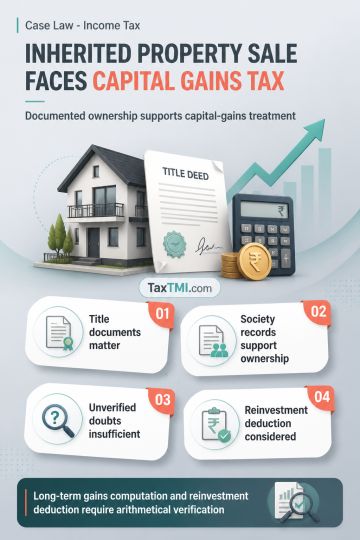
Inherited property sale proceeds require capital-gains treatment where ownership is supported by evidence, not suspicion or unverified signature doubt...
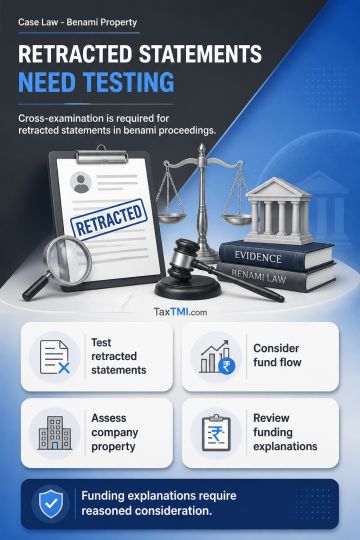
Cross-examination of retracted statements is essential where foundational evidence supports a benami allegation and documented funding explanations re...
Capital-goods exemption covers plant-modernisation accessories, while the import restriction applies only to earlier capital-goods components and spar...
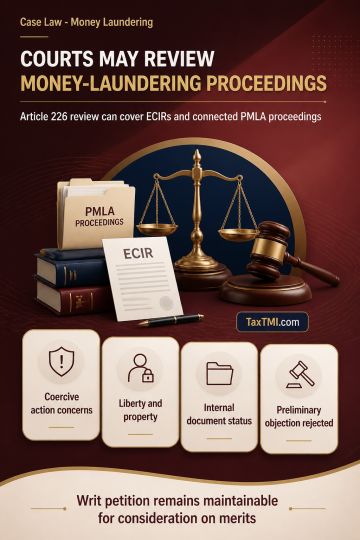
Constitutional judicial review permits challenges to ECIRs and connected money-laundering proceedings where coercive action affects fundamental intere...
The High Court held that the show cause notices issued by the respondent u/s 73 of the Central Goods and Services Tax (CGST) Act, 2017, were flawed due to the improper consolidation of multiple tax periods into a single notice. Section 73(10) mandates a specific time limit from the due date for furnishing the annual return for the financial year to which the tax due relates. The law requires particular actions to be completed within a designated year, in accordance with the provisions. The Court found that issuing a consolidated show cause notice for multiple assessment years from 2017-18 to 2020-21 contravened the CGST Act and established legal precedents, such as the Supreme Court judgment in THE STATE OF JAMMU AND KASHMIR AND OTHERS VERSUS CALTEX (INDIA) LTD. The Court concluded that the respondent erred in this practice and allowed the petition.
The High Court held that the show cause notices issued by the respondent u/s 73 of the Central Goods and Services Tax (CGST) Act, 2017, were flawed due to the improper consolidation of multiple tax periods into a single notice. Section 73(10) mandates a specific time limit from the due date for furnishing the annual return for the financial year to which the tax due relates. The law requires particular actions to be completed within a designated year, in accordance with the provisions. The Court found that issuing a consolidated show cause notice for multiple assessment years from 2017-18 to 2020-21 contravened the CGST Act and established legal precedents, such as the Supreme Court judgment in THE STATE OF JAMMU AND KASHMIR AND OTHERS VERSUS CALTEX (INDIA) LTD. The Court concluded that the respondent erred in this practice and allowed the petition.
Note: It is a system-generated summary and is for quick reference only.
 TaxTMI
 of 4805












 Join Channel


 TaxTMI