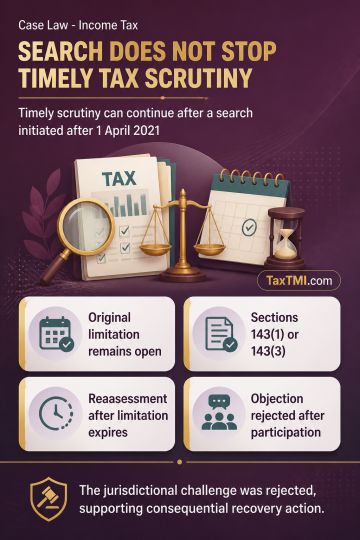
Post-search scrutiny assessment remains available where original assessment limitation is unexpired, permitting timely completion under regular assess...
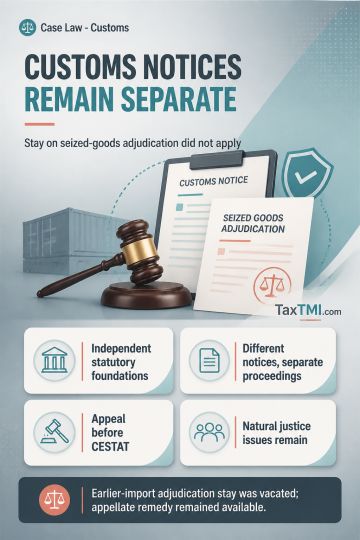
Independent show-cause notices remain separate proceedings, while customs adjudication challenges should ordinarily follow the statutory appellate rem...
Page of 4805
Press 'Enter' after typing page number.
461 to 480 of 96092 Results
❮
❯
❯❯
0 / 200
Expand Note
Add to Folder
No Folders have been created
+
Are you sure you want to delete "My most important" ?
The High Court held that the show cause notices issued by the respondent u/s 73 of the Central Goods and Services Tax (CGST) Act, 2017, were flawed due to the improper consolidation of multiple tax periods into a single notice. Section 73(10) mandates a specific time limit from the due date for furnishing the annual return for the financial year to which the tax due relates. The law requires particular actions to be completed within a designated year, in accordance with the provisions. The Court found that issuing a consolidated show cause notice for multiple assessment years from 2017-18 to 2020-21 contravened the CGST Act and established legal precedents, such as the Supreme Court judgment in THE STATE OF JAMMU AND KASHMIR AND OTHERS VERSUS CALTEX (INDIA) LTD. The Court concluded that the respondent erred in this practice and allowed the petition.
The High Court held that the show cause notices issued by the respondent u/s 73 of the Central Goods and Services Tax (CGST) Act, 2017, were flawed due to the improper consolidation of multiple tax periods into a single notice. Section 73(10) mandates a specific time limit from the due date for furnishing the annual return for the financial year to which the tax due relates. The law requires particular actions to be completed within a designated year, in accordance with the provisions. The Court found that issuing a consolidated show cause notice for multiple assessment years from 2017-18 to 2020-21 contravened the CGST Act and established legal precedents, such as the Supreme Court judgment in THE STATE OF JAMMU AND KASHMIR AND OTHERS VERSUS CALTEX (INDIA) LTD. The Court concluded that the respondent erred in this practice and allowed the petition.
Note: It is a system-generated summary and is for quick reference only.
 TaxTMI
 of 4805






 Join Channel


 TaxTMI