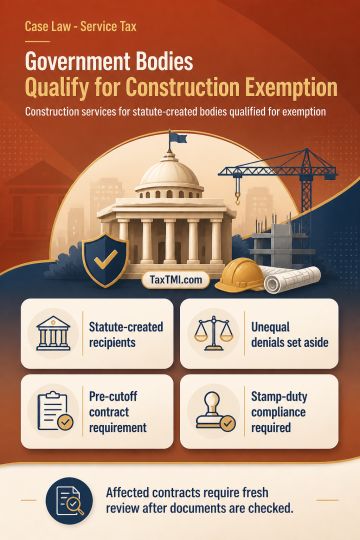
Governmental authority status supports construction-service exemption, while pre-cutoff contract and stamp-duty compliance requires verification on re...
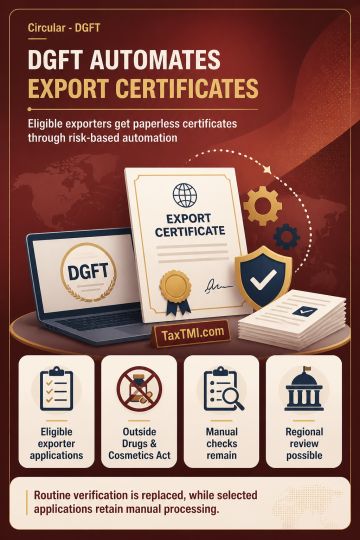
Automated Free Sale and Commerce Certificates enable paperless processing while retaining risk-based manual verification for selected exporter applica...
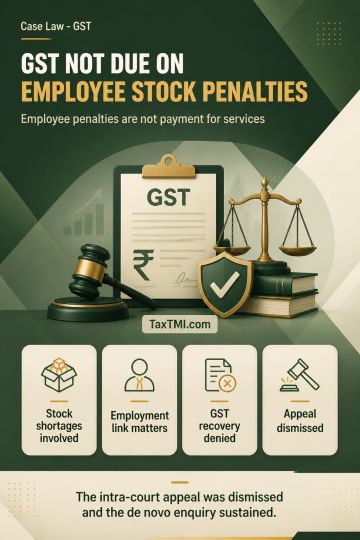
Employee stock-shortage penalties do not constitute consideration for services, preventing GST collection under Schedule II in employment relationship...
The key points are: misdeclaration of goods by the importer cannot render the Customs House Agent (CHA) vicariously liable for penalty u/s 112(a) of the Customs Act 1962. To impose penalty, there must be a positive act or omission by the CHA rendering the goods liable for confiscation. Mere abetment by the CHA's employees is insufficient without evidence of illegal acts. The Tribunal's decision in Rajesh Maikhuri's case supports this view. Consequently, the penalty imposed on the appellant CHA is unsustainable and set aside.
The key points are: misdeclaration of goods by the importer cannot render the Customs House Agent (CHA) vicariously liable for penalty u/s 112(a) of the Customs Act 1962. To impose penalty, there must be a positive act or omission by the CHA rendering the goods liable for confiscation. Mere abetment by the CHA's employees is insufficient without evidence of illegal acts. The Tribunal's decision in Rajesh Maikhuri's case supports this view. Consequently, the penalty imposed on the appellant CHA is unsustainable and set aside.
Note: It is a system-generated summary and is for quick reference only.
 TaxTMI
  TaxTMI
 of 4828





 Join Channel


