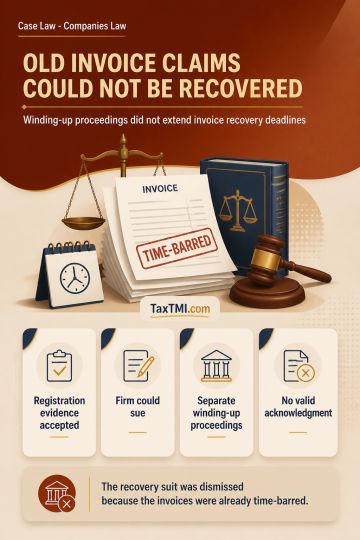
Invoice-based recovery claims remain time-barred despite separate winding-up proceedings, absent valid acknowledgment or part-payment of the disputed ...
Extended limitation fails without specific suppression allegations, while overseas employee secondment remains taxable as manpower supply within norma...
Time-share accommodation classification excludes Club or Association Service where purchasers receive contractual occupancy rights without genuine mem...
CENVAT credit for trading requires reversal, while taxable-service rental credit remains proportionately available and limitation issues await resolut...
Vicarious liability for dishonoured company cheques may extend to non-signatory directors where complaints contain foundational responsibility avermen...
The petitioner failed to challenge the matter within statutory provisions and raised the constitutional validity of Section 29(2) under CGST and BGST Acts. The court found the decision in Rohit Enterprises persuasive but not binding. While the facts differed, the hardship was similar to a previous case where the constitutional guarantee to carry out trade and commerce was upheld. No valid ground was raised against the delay in filing an appeal, as Section 30 allows revocation of cancellation within 30 days. The court found no reason to exercise discretionary power or entertain the writ petition testing Section 29(2)'s constitutional validity, as the orders were within statutory boundaries. Consequently, the writ petition was dismissed.
The petitioner failed to challenge the matter within statutory provisions and raised the constitutional validity of Section 29(2) under CGST and BGST Acts. The court found the decision in Rohit Enterprises persuasive but not binding. While the facts differed, the hardship was similar to a previous case where the constitutional guarantee to carry out trade and commerce was upheld. No valid ground was raised against the delay in filing an appeal, as Section 30 allows revocation of cancellation within 30 days. The court found no reason to exercise discretionary power or entertain the writ petition testing Section 29(2)'s constitutional validity, as the orders were within statutory boundaries. Consequently, the writ petition was dismissed.
Note: It is a system-generated summary and is for quick reference only.
 TaxTMI
 of 4803












 Join Channel


 TaxTMI