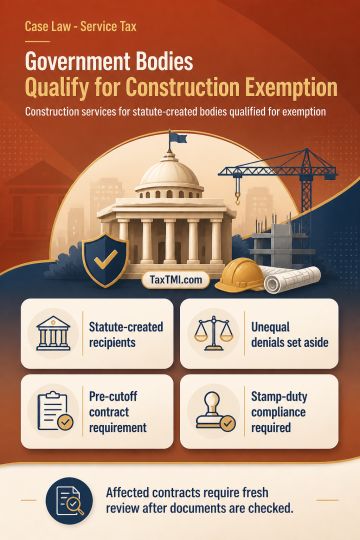
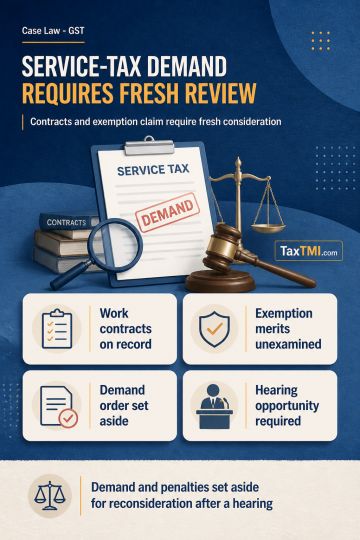
Governmental authority status supports construction-service exemption, while pre-cutoff contract and stamp-duty compliance requires verification on re...
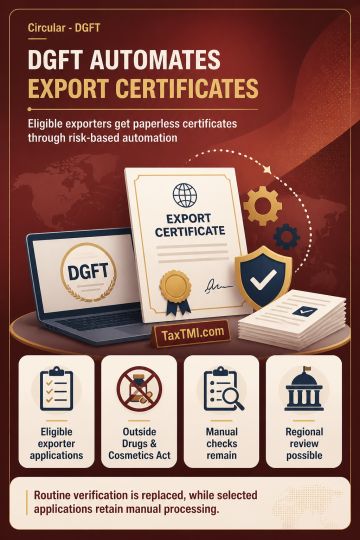
Automated Free Sale and Commerce Certificates enable paperless processing while retaining risk-based manual verification for selected exporter applica...
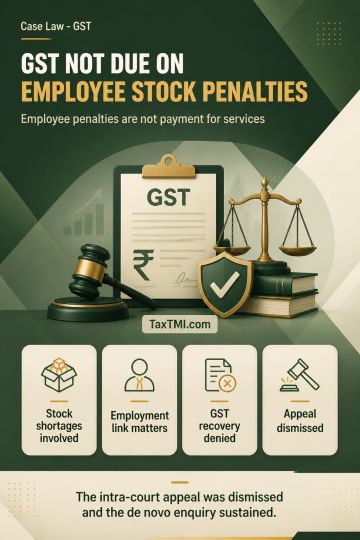
Employee stock-shortage penalties do not constitute consideration for services, preventing GST collection under Schedule II in employment relationship...
The case pertains to the valuation of imported porcelain vitrified tiles. The key points are: The assessment attained finality, but the appellant has the legal right to challenge the assessment order u/s 128 of the Customs Act, 1962, as per the Supreme Court's judgment in ITC LIMITED VERSUS COMMISSIONER OF CENTRAL EXCISE, KOLKATA -IV. The NIDB (National Import Database) data cannot be the sole basis for rejecting the declared value. Comparing goods imported by different importers is unjustified. The adjudication authority acknowledged that the goods are not branded, and identical goods are unavailable for comparison. The impugned order lacks admissible evidence to reject the transaction value. Details of other imports were not furnished, and there is no mention of the lowest value among contemporaneous imports to ascertain if such imports can reject the declared value. The value enhancement was made without following the Customs Valuation (Determination of Value of Imported Goods) Rules, 2007. Therefore, the declared value must be adopted for assessment. The appeal was allowed.
The case pertains to the valuation of imported porcelain vitrified tiles. The key points are: The assessment attained finality, but the appellant has the legal right to challenge the assessment order u/s 128 of the Customs Act, 1962, as per the Supreme Court's judgment in ITC LIMITED VERSUS COMMISSIONER OF CENTRAL EXCISE, KOLKATA -IV. The NIDB (National Import Database) data cannot be the sole basis for rejecting the declared value. Comparing goods imported by different importers is unjustified. The adjudication authority acknowledged that the goods are not branded, and identical goods are unavailable for comparison. The impugned order lacks admissible evidence to reject the transaction value. Details of other imports were not furnished, and there is no mention of the lowest value among contemporaneous imports to ascertain if such imports can reject the declared value. The value enhancement was made without following the Customs Valuation (Determination of Value of Imported Goods) Rules, 2007. Therefore, the declared value must be adopted for assessment. The appeal was allowed.
Note: It is a system-generated summary and is for quick reference only.
 TaxTMI
  TaxTMI
 of 4828



 Join Channel


