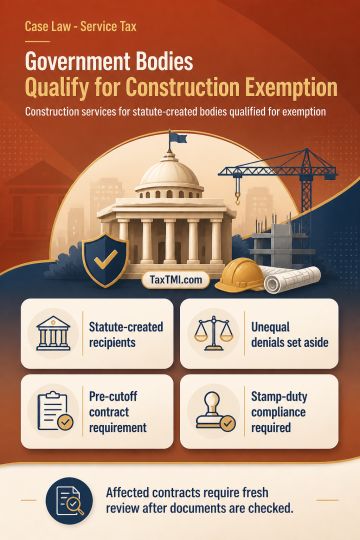
Governmental authority status supports construction-service exemption, while pre-cutoff contract and stamp-duty compliance requires verification on re...
Automated Free Sale and Commerce Certificates enable paperless processing while retaining risk-based manual verification for selected exporter applica...
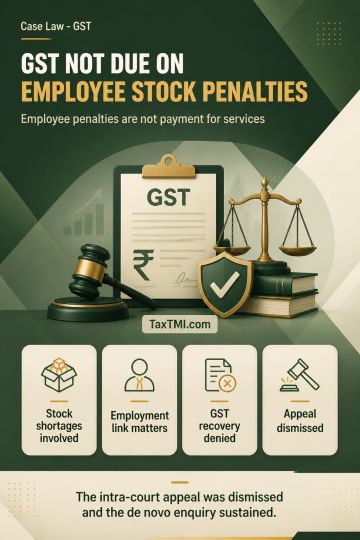
Employee stock-shortage penalties do not constitute consideration for services, preventing GST collection under Schedule II in employment relationship...
Issue of reassessment u/s 263, where the Commissioner of Income Tax (CIT) upheld the reassessment as erroneous and prejudicial to the Revenue's interest for verification of transactions related to NSEL commodities and provision for bad debt claimed by the assessee. The Tribunal relied on the Bombay High Court's decisions in Marico Ltd. and GKN Sinter Metals Ltd., which held that if a query was raised by the Assessing Officer (AO) during the assessment proceedings and the assessee responded, it implies the AO accepted the assessee's submission. If the assessment order does not reflect consideration of the issue, it means no opinion was formed by the AO. In this case, the issues of NSEL transactions and bad debt provision were considered by the AO during the original and reassessment proceedings. The AO verified the complete facts and framed the assessment u/s 147 read with Section 144B after examining the details provided by the assessee. The Tribunal found no error in the reassessment order prejudicial to the Revenue's interest and quashed the CIT's revision order, allowing the assessee's appeal.
Issue of reassessment u/s 263, where the Commissioner of Income Tax (CIT) upheld the reassessment as erroneous and prejudicial to the Revenue's interest for verification of transactions related to NSEL commodities and provision for bad debt claimed by the assessee. The Tribunal relied on the Bombay High Court's decisions in Marico Ltd. and GKN Sinter Metals Ltd., which held that if a query was raised by the Assessing Officer (AO) during the assessment proceedings and the assessee responded, it implies the AO accepted the assessee's submission. If the assessment order does not reflect consideration of the issue, it means no opinion was formed by the AO. In this case, the issues of NSEL transactions and bad debt provision were considered by the AO during the original and reassessment proceedings. The AO verified the complete facts and framed the assessment u/s 147 read with Section 144B after examining the details provided by the assessee. The Tribunal found no error in the reassessment order prejudicial to the Revenue's interest and quashed the CIT's revision order, allowing the assessee's appeal.
Note: It is a system-generated summary and is for quick reference only.
 TaxTMI
  TaxTMI
 of 4828











 Join Channel


