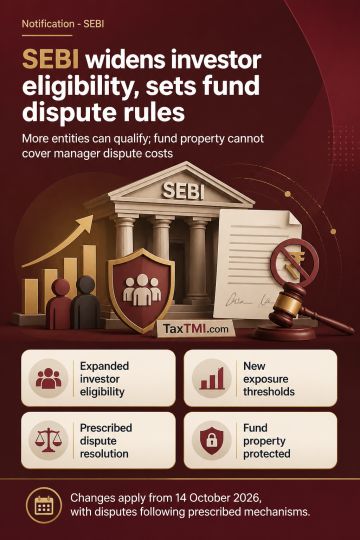
Accredited investor eligibility expands through securities-market exposure, while alternative investment fund disputes require prescribed resolution a...
Customs Assessment Portal centralises classification and valuation guidance to support consistent, transparent and informed compliance across stakehol...
The circular enhances monetary limits for filing appeals by the Income Tax Department before Income Tax Appellate Tribunal, High Courts, and Supreme Court. For appeals before ITAT, limit is Rs. 60 lakh, Rs. 2 crore for High Courts, and Rs. 5 crore for Supreme Court. Exceptions apply for cases involving tax deduction/collection at source, where decision is merit-based. Appeals should not be filed solely due to exceeding monetary limits; merits must be considered to reduce unnecessary litigation and provide certainty. Modifications are effective immediately, applying to pending and future appeals, which may be withdrawn if exceeding revised limits.
The circular enhances monetary limits for filing appeals by the Income Tax Department before Income Tax Appellate Tribunal, High Courts, and Supreme Court. For appeals before ITAT, limit is Rs. 60 lakh, Rs. 2 crore for High Courts, and Rs. 5 crore for Supreme Court. Exceptions apply for cases involving tax deduction/collection at source, where decision is merit-based. Appeals should not be filed solely due to exceeding monetary limits; merits must be considered to reduce unnecessary litigation and provide certainty. Modifications are effective immediately, applying to pending and future appeals, which may be withdrawn if exceeding revised limits.
Note: It is a system-generated summary and is for quick reference only.
 TaxTMI
  TaxTMI
 of 4921