Governmental authority status supports construction-service exemption, while pre-cutoff contract and stamp-duty compliance requires verification on re...
Automated Free Sale and Commerce Certificates enable paperless processing while retaining risk-based manual verification for selected exporter applica...
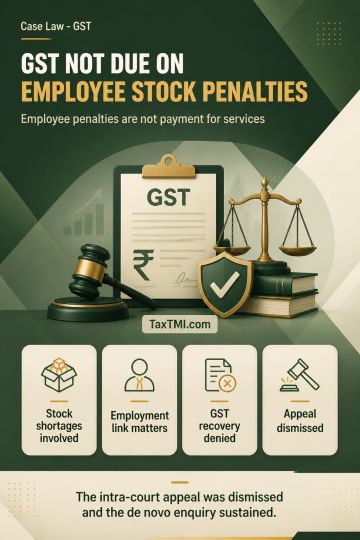
Employee stock-shortage penalties do not constitute consideration for services, preventing GST collection under Schedule II in employment relationship...
The ITAT examined whether the takeover of immovable properties by a financial institution from the guarantor, against loans granted to companies where the guarantor stood as guarantor, would result in taxable capital gains for the guarantor. The sale deed did not mention enforcement of the guarantee clause but cited repayment of loans as the reason. Despite mortgages earlier, the properties were sold free from encumbrances. The ITAT held that the transaction met the definition of 'transfer' u/s 2(47), attracting Sections 45 and 48 for computing capital gains, which the authorities rightly did. The ITAT rejected the assessee's contention of compulsion, noting the short timeframe for loans turning bad, the guarantor's directorship and shareholding in the companies, and the accrual of a valuable right as a creditor upon stepping into the shoes of the financial institution. The ITAT upheld the taxability of capital gains, aligning with the Supreme Court's decision in Attili N Rao's case. The revenue's stance was upheld.
The ITAT examined whether the takeover of immovable properties by a financial institution from the guarantor, against loans granted to companies where the guarantor stood as guarantor, would result in taxable capital gains for the guarantor. The sale deed did not mention enforcement of the guarantee clause but cited repayment of loans as the reason. Despite mortgages earlier, the properties were sold free from encumbrances. The ITAT held that the transaction met the definition of 'transfer' u/s 2(47), attracting Sections 45 and 48 for computing capital gains, which the authorities rightly did. The ITAT rejected the assessee's contention of compulsion, noting the short timeframe for loans turning bad, the guarantor's directorship and shareholding in the companies, and the accrual of a valuable right as a creditor upon stepping into the shoes of the financial institution. The ITAT upheld the taxability of capital gains, aligning with the Supreme Court's decision in Attili N Rao's case. The revenue's stance was upheld.
Note: It is a system-generated summary and is for quick reference only.
 TaxTMI
  TaxTMI
 of 4828













 Join Channel


