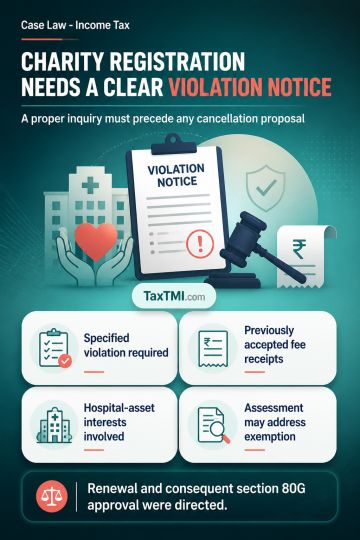
Charitable trust registration requires a specified-violation notice; settled cash deposits and related-party payments did not justify cancellation or ...
External development charges trigger TDS under section 194C, while disputed administrative payments require factual verification and fresh adjudicatio...
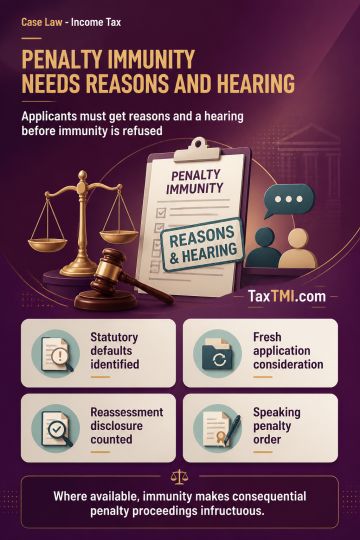
Section 270AA penalty immunity requires identified statutory defaults and a hearing before rejection; reassessment disclosure may constitute under-rep...
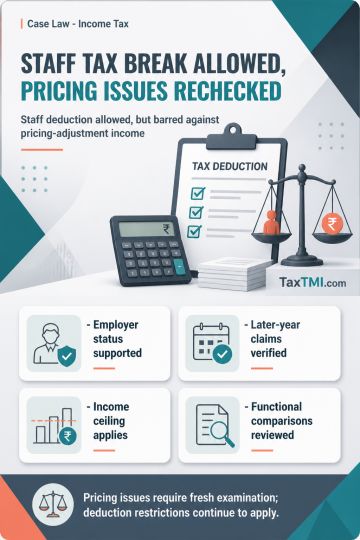
Section 80JJAA employee-cost deduction allowed for deployed staff but barred against transfer-pricing income enhancement, with pricing issues remanded...
Transfer-pricing methodology protects commercially genuine associated-enterprise payments, while pre-2016 secondary adjustments and related notional i...
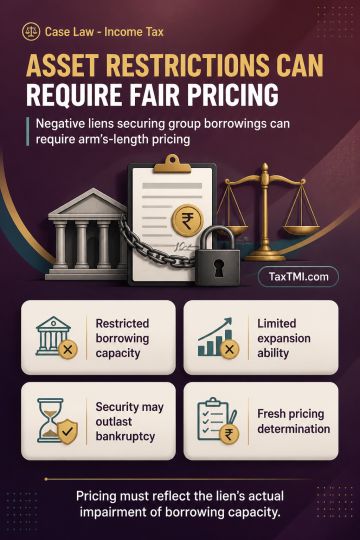
Negative liens over operating assets can constitute international transactions requiring arm's-length pricing reflecting restricted borrowing and expa...
Cross-examination rights in Customs Broker revocation inquiries require witness examination; procedural denial may be cured through fresh adjudication...
The petition challenges the arrest of the petitioner u/s 19(1) of the Prevention of Money Laundering Act (PMLA), 2002, alleging non-compliance with the requirement of informing the grounds of arrest. However, the arrest memo indicates that the petitioner refused to receive it after being informed of the grounds. The Court finds no illegality in the arrest procedure. The Court acknowledges the petitioner's right to make successive bail applications and its duty to consider the reasons for earlier rejections. It upholds its previous findings that the Enforcement Directorate has collected material satisfying the presumptions u/ss 22 and 23 of the PMLA, and the petitioner cannot be held "not guilty" at this stage. The Court cites a recent Supreme Court judgment in Manish Sisodia, which held that the right to bail in cases of delay and long incarceration should be read into Section 439 of the Code of Criminal Procedure and Section 45 of the PMLA. Section 479 of the Bharatiya Nagarik Suraksha Sanhita, 2023, as amended, mandates the release of a first-time offender on bond if they have undergone detention for up to one-third of the maximum imprisonment period for the offence. The petitioner, being in custody for about two years.
The petition challenges the arrest of the petitioner u/s 19(1) of the Prevention of Money Laundering Act (PMLA), 2002, alleging non-compliance with the requirement of informing the grounds of arrest. However, the arrest memo indicates that the petitioner refused to receive it after being informed of the grounds. The Court finds no illegality in the arrest procedure. The Court acknowledges the petitioner's right to make successive bail applications and its duty to consider the reasons for earlier rejections. It upholds its previous findings that the Enforcement Directorate has collected material satisfying the presumptions u/ss 22 and 23 of the PMLA, and the petitioner cannot be held "not guilty" at this stage. The Court cites a recent Supreme Court judgment in Manish Sisodia, which held that the right to bail in cases of delay and long incarceration should be read into Section 439 of the Code of Criminal Procedure and Section 45 of the PMLA. Section 479 of the Bharatiya Nagarik Suraksha Sanhita, 2023, as amended, mandates the release of a first-time offender on bond if they have undergone detention for up to one-third of the maximum imprisonment period for the offence. The petitioner, being in custody for about two years.
Note: It is a system-generated summary and is for quick reference only.
 TaxTMI
  TaxTMI
 of 4828



















 Join Channel


