Opportunity to respond to jurisdictional reports is mandatory before customs settlement duty enhancement; connected applications require consistent ad...
Specific customs headings for scaffolding components prevail over general classification, invalidating misclassification proceedings and enabling with...
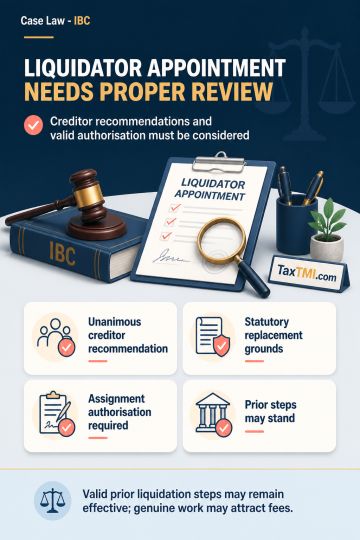
Liquidator appointment under Section 34 requires consideration of creditor recommendations, valid professional authorisation, and preservation of vali...
The High Court held that the Assessing Officer cannot reopen the assessment u/s 147 merely based on a change of opinion. The assessee had fully and truly disclosed all material facts during the original assessment proceedings. The reasons recorded by the Assessing Officer for reopening the assessment did not reveal any fresh tangible material, indicating that the belief was formed based on a mere verification of records, resulting in a change of opinion. The Court emphasized the conceptual difference between the power to review and the power to reassess, stating that while the Assessing Officer lacks the power to review, reassessment must be based on fulfilling certain preconditions. Removing the concept of "change of opinion" would allow the Assessing Officer to review assessments under the guise of reopening, leading to potential abuse of power. The Court ruled in favor of the assessee, upholding the principle that a mere change of opinion cannot justify reassessment proceedings.
The High Court held that the Assessing Officer cannot reopen the assessment u/s 147 merely based on a change of opinion. The assessee had fully and truly disclosed all material facts during the original assessment proceedings. The reasons recorded by the Assessing Officer for reopening the assessment did not reveal any fresh tangible material, indicating that the belief was formed based on a mere verification of records, resulting in a change of opinion. The Court emphasized the conceptual difference between the power to review and the power to reassess, stating that while the Assessing Officer lacks the power to review, reassessment must be based on fulfilling certain preconditions. Removing the concept of "change of opinion" would allow the Assessing Officer to review assessments under the guise of reopening, leading to potential abuse of power. The Court ruled in favor of the assessee, upholding the principle that a mere change of opinion cannot justify reassessment proceedings.
Note: It is a system-generated summary and is for quick reference only.
 TaxTMI
 of 4792













 Join Channel


 TaxTMI