Prolonged sterilisation of development rights supports capital-gains treatment, while business-income disallowances cannot govern capital-gains comput...
Additional evidence in transfer pricing dispute leads to fresh examination, while tax deductions, TDS credit, fee and refund interest require verifica...
Category II AIF pass-through taxation preserves non-business income character; investment receipts cannot be reclassified without applying recognised ...
Mutual fund maturity rules require proper rollover, redemption, disclosure, and due diligence; investor gains cannot excuse regulatory breaches or pen...
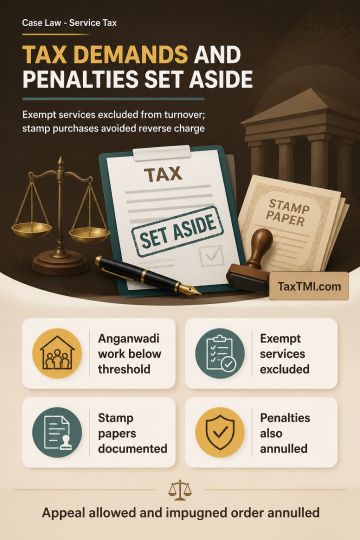
Threshold exemption excludes exempt services, while stamp-paper purchases avoid reverse charge; consequential service tax penalties were also set asid...
This case deals with the accrual of income in India from exploration activities and the determination of whether the assessee has a Permanent Establishment (PE) in India under the India-Singapore DTAA. The key points are: The Assessing Officer treated the gross receipts attributed to the PE as deemed profits u/s 44BB and made an addition. The assessee contended that its operations were less than 183 days, covered under Article 5(5) of the DTAA, a special clause for exploration activities, rather than Article 5(1), the general PE clause. The Tribunal held that for specific activities defined in Article 5(5), the minimum period test of 183 days must be applied, and this specific activity-based article prevails over the general rule of Article 5(1). Since the assessee's activities were for less than 183 days, it did not have a PE in India under Article 5(5). Article 5(3) is an exception to Articles 5(1) and 5(2) and prevails as a specific provision. The Tribunal found merit in the assessee's appeal and deleted the addition made by the Assessing Officer.
This case deals with the accrual of income in India from exploration activities and the determination of whether the assessee has a Permanent Establishment (PE) in India under the India-Singapore DTAA. The key points are: The Assessing Officer treated the gross receipts attributed to the PE as deemed profits u/s 44BB and made an addition. The assessee contended that its operations were less than 183 days, covered under Article 5(5) of the DTAA, a special clause for exploration activities, rather than Article 5(1), the general PE clause. The Tribunal held that for specific activities defined in Article 5(5), the minimum period test of 183 days must be applied, and this specific activity-based article prevails over the general rule of Article 5(1). Since the assessee's activities were for less than 183 days, it did not have a PE in India under Article 5(5). Article 5(3) is an exception to Articles 5(1) and 5(2) and prevails as a specific provision. The Tribunal found merit in the assessee's appeal and deleted the addition made by the Assessing Officer.
Note: It is a system-generated summary and is for quick reference only.
 TaxTMI
 of 4805


















 Join Channel


 TaxTMI
