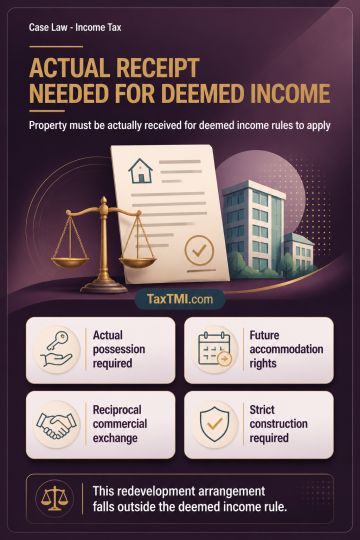
Receipt of immovable property requires actual possession or enjoyment; redevelopment allotments exchanged for tenancy rights fall outside deemed incom...
Section 80P deduction covers Souharda credit societies, including qualifying surplus-deposit interest, subject to member KYC verification for cash dep...
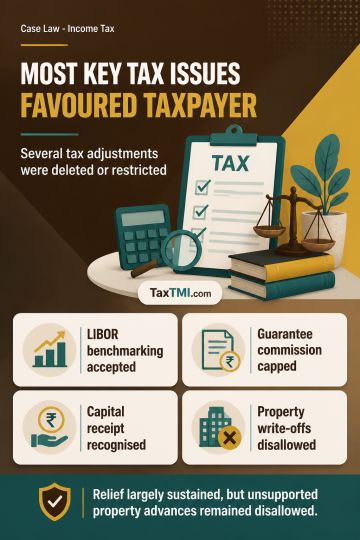
Transfer-pricing benchmarking and capital-receipt principles sustained taxpayer relief, while unsupported property-advance write-offs remained disallo...
Page of 4801
Press 'Enter' after typing page number.
941 to 960 of 96001 Results
❮
❯
❯❯
0 / 200
Expand Note
Add to Folder
No Folders have been created
+
Are you sure you want to delete "My most important" ?
This case deals with the accrual of income in India from exploration activities and the determination of whether the assessee has a Permanent Establishment (PE) in India under the India-Singapore DTAA. The key points are: The Assessing Officer treated the gross receipts attributed to the PE as deemed profits u/s 44BB and made an addition. The assessee contended that its operations were less than 183 days, covered under Article 5(5) of the DTAA, a special clause for exploration activities, rather than Article 5(1), the general PE clause. The Tribunal held that for specific activities defined in Article 5(5), the minimum period test of 183 days must be applied, and this specific activity-based article prevails over the general rule of Article 5(1). Since the assessee's activities were for less than 183 days, it did not have a PE in India under Article 5(5). Article 5(3) is an exception to Articles 5(1) and 5(2) and prevails as a specific provision. The Tribunal found merit in the assessee's appeal and deleted the addition made by the Assessing Officer.
This case deals with the accrual of income in India from exploration activities and the determination of whether the assessee has a Permanent Establishment (PE) in India under the India-Singapore DTAA. The key points are: The Assessing Officer treated the gross receipts attributed to the PE as deemed profits u/s 44BB and made an addition. The assessee contended that its operations were less than 183 days, covered under Article 5(5) of the DTAA, a special clause for exploration activities, rather than Article 5(1), the general PE clause. The Tribunal held that for specific activities defined in Article 5(5), the minimum period test of 183 days must be applied, and this specific activity-based article prevails over the general rule of Article 5(1). Since the assessee's activities were for less than 183 days, it did not have a PE in India under Article 5(5). Article 5(3) is an exception to Articles 5(1) and 5(2) and prevails as a specific provision. The Tribunal found merit in the assessee's appeal and deleted the addition made by the Assessing Officer.
Note: It is a system-generated summary and is for quick reference only.
 TaxTMI
 of 4801














 Join Channel


 TaxTMI