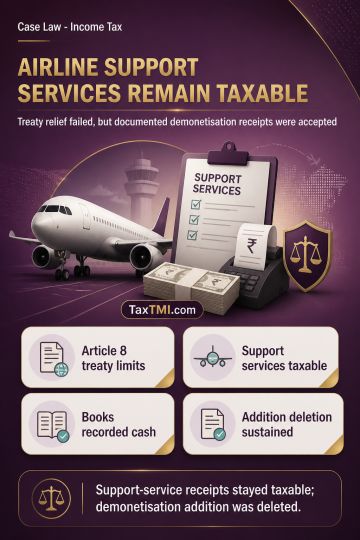
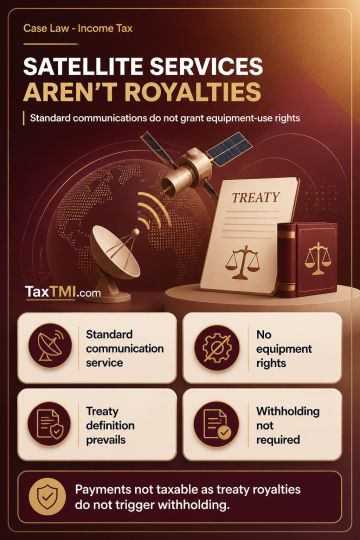
Article 8 treaty coverage excluded third-party airline support services, while documented demonetisation cash receipts remained accepted business inco...
Functional comparability under TNMM requires highway contract benchmarks to reflect operation, maintenance and transfer activities, requiring fresh be...
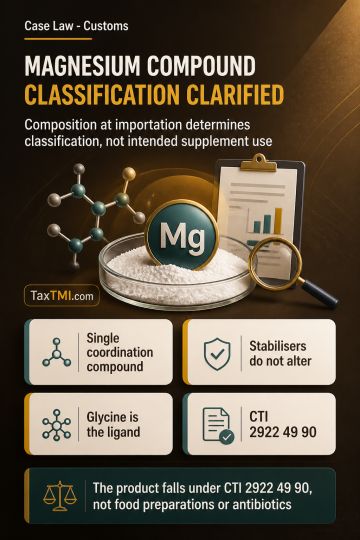
Objective characteristics govern magnesium bis-glycinate chelate classification as an amino-acid coordination compound, not a food preparation or anti...
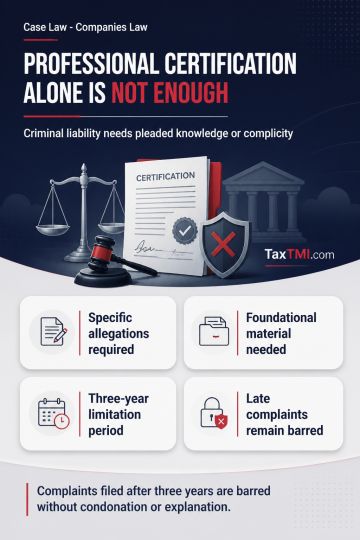
Independent professional certification requires pleaded knowledge or complicity for criminal liability; untimely complaints remain barred by limitatio...
The High Court dismissed the appeal filed by the assessing officer against the order of the Income Tax Appellate Tribunal, holding that no substantial question of law arises for consideration. The Tribunal had deleted the additions made by the assessing officer after rejecting the books of accounts of the assessee u/s 145(3) and making an ex-parte assessment u/s 144. The Court observed that the Tribunal, being the final fact-finding authority, had dealt with all grounds raised by the appellant in a well-reasoned order based on the material on record. The Court stated that a finding of fact may give rise to a substantial question of law if it is based on no evidence, relevant admissible evidence is not considered, inadmissible evidence is taken into account, or legal principles are not applied in appreciating the evidence. However, in this case, the appellant had merely disputed the factual findings of the Tribunal under the guise of substantial questions of law, which is not permitted by the statute. The Court held that no question of law, let alone a substantial question of law, arose from the Tribunal's order, and there was no merit in the appeal.
The High Court dismissed the appeal filed by the assessing officer against the order of the Income Tax Appellate Tribunal, holding that no substantial question of law arises for consideration. The Tribunal had deleted the additions made by the assessing officer after rejecting the books of accounts of the assessee u/s 145(3) and making an ex-parte assessment u/s 144. The Court observed that the Tribunal, being the final fact-finding authority, had dealt with all grounds raised by the appellant in a well-reasoned order based on the material on record. The Court stated that a finding of fact may give rise to a substantial question of law if it is based on no evidence, relevant admissible evidence is not considered, inadmissible evidence is taken into account, or legal principles are not applied in appreciating the evidence. However, in this case, the appellant had merely disputed the factual findings of the Tribunal under the guise of substantial questions of law, which is not permitted by the statute. The Court held that no question of law, let alone a substantial question of law, arose from the Tribunal's order, and there was no merit in the appeal.
Note: It is a system-generated summary and is for quick reference only.
 TaxTMI
 of 4800









 Join Channel


 TaxTMI
