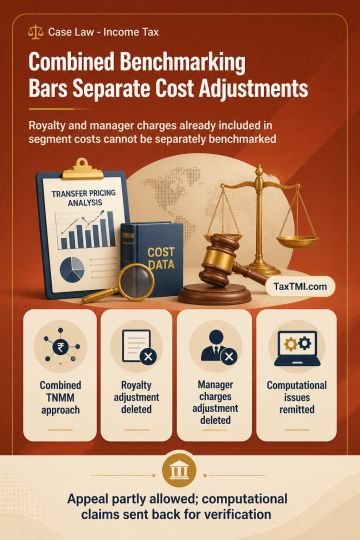
Prolonged sterilisation of development rights supports capital-gains treatment, while business-income disallowances cannot govern capital-gains comput...
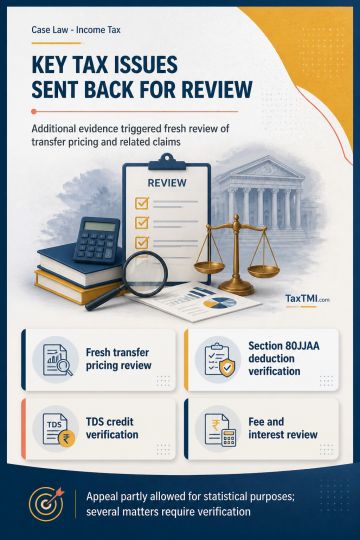
Additional evidence in transfer pricing dispute leads to fresh examination, while tax deductions, TDS credit, fee and refund interest require verifica...
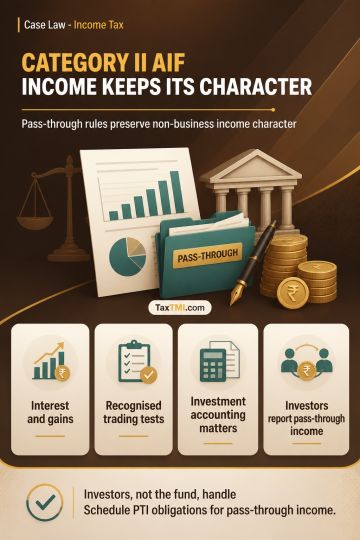
Category II AIF pass-through taxation preserves non-business income character; investment receipts cannot be reclassified without applying recognised ...
Mutual fund maturity rules require proper rollover, redemption, disclosure, and due diligence; investor gains cannot excuse regulatory breaches or pen...
Threshold exemption excludes exempt services, while stamp-paper purchases avoid reverse charge; consequential service tax penalties were also set asid...
The case pertains to the revision of an assessment order u/s 263 regarding the applicability of the higher tax rate u/s 115BBE on unexplained expenditure u/s 69C. The assessee had purchased excess stock using unexplained funds, which the Assessing Officer (AO) treated as unexplained expenditure but charged tax at normal rates. The Principal Commissioner of Income Tax (PCIT) invoked Section 263, contending that the higher tax rate u/s 115BBE should have been applied. However, the Tribunal held that when the AO has conducted proper inquiries and taken a plausible view, the PCIT cannot substitute their view for the AO's unless the AO's view is unsustainable in law. The Tribunal relied on the Supreme Court's decision in Malabar Industrial Co. Ltd., which stated that every loss of revenue due to the AO's order cannot be treated as prejudicial to revenue interests u/s 263. If two views are possible and the AO has taken one view, it cannot be treated as an erroneous order unless the AO's view is unsustainable in law. Consequently, the Tribunal decided in favor of the assessee.
The case pertains to the revision of an assessment order u/s 263 regarding the applicability of the higher tax rate u/s 115BBE on unexplained expenditure u/s 69C. The assessee had purchased excess stock using unexplained funds, which the Assessing Officer (AO) treated as unexplained expenditure but charged tax at normal rates. The Principal Commissioner of Income Tax (PCIT) invoked Section 263, contending that the higher tax rate u/s 115BBE should have been applied. However, the Tribunal held that when the AO has conducted proper inquiries and taken a plausible view, the PCIT cannot substitute their view for the AO's unless the AO's view is unsustainable in law. The Tribunal relied on the Supreme Court's decision in Malabar Industrial Co. Ltd., which stated that every loss of revenue due to the AO's order cannot be treated as prejudicial to revenue interests u/s 263. If two views are possible and the AO has taken one view, it cannot be treated as an erroneous order unless the AO's view is unsustainable in law. Consequently, the Tribunal decided in favor of the assessee.
Note: It is a system-generated summary and is for quick reference only.
 TaxTMI
 of 4805












 Join Channel


 TaxTMI
